

Post a "Laravel developer" job opening, and you'll get applications from WordPress developers who've never touched Laravel, developers stuck on Laravel 5.x from 2015 when you need Laravel 10+ expertise, and backend specialists when your stack requires full-stack Livewire knowledge. It's the most expensive hiring mistake we see companies make.
Laravel 11, released in 2024, requires PHP 8.2+ and uses completely different architectural patterns than Laravel 5.x. These aren't just version differences - they're fundamentally different skill sets requiring different vetting approaches.
We've hired 150+ remote developers and interviewed 1,500+ candidates across every technical role. Through that process, we've built a Laravel-specific vetting methodology that distinguishes modern framework expertise from generic PHP experience.
This guide provides the exact version specifications, technical distinctions, screening questions, and hiring framework to fill Laravel roles in 4-6 weeks instead of 12+ weeks.
Key Takeaways for Hiring Modern Laravel Developers
Specify framework version, not just "PHP developer"
- "PHP developer" attracts WordPress developers and custom PHP programmers unfamiliar with Laravel
- Always specify "Laravel Developer (Laravel 10+)" to filter for modern expertise
- 3 years of modern Laravel 10+ experience beats 7 years of generic PHP or WordPress development
Laravel version determines skill relevance
- Laravel 11 (2024) and Laravel 10 (2023 LTS) require PHP 8.1-8.2+ with modern patterns
- Laravel 5.x-8.x (pre-2022) use outdated approaches requiring 2-3 months retraining
- Specify "Laravel 10+" or "Laravel 11" explicitly in job postings
Clarify the frontend integration approach upfront
- Livewire (modern full-stack staying in Laravel), Inertia.js + Vue/React (SPA with Laravel backend), Blade templates (traditional server-side), or headless API-only
- Developers specialize - a Livewire expert isn't an Inertia.js expert
Test Laravel-specific skills, not generic PHP
- Test Eloquent relationships and N+1 query prevention, queues and job processing, events and service providers
- Generic PHP algorithm tests miss framework expertise entirely
When Do You Need Laravel Developers
- Building web applications (SaaS platforms, e-commerce, enterprise apps)
- Creating RESTful APIs for mobile apps and frontend frameworks
- Developing full-stack applications using Livewire or Inertia.js
- Maintaining or upgrading existing Laravel applications
- Migrating legacy PHP codebases to modern Laravel
- Building custom packages or extending framework functionality
Ready to hire the right Laravel specialist? Book a free consultation with Remote Crew and get your first qualified candidates within 48 hours.
Modern Laravel vs Legacy PHP Development
"Laravel developer" without version specification attracts WordPress developers who've never touched Laravel, developers stuck on Laravel 5.x from 2015, when you need Laravel 10+, backend specialists when you need full-stack Livewire expertise.
The framework has evolved dramatically - "Laravel experience" means nothing without version and frontend approach specified.
Modern Laravel Developer (Laravel 10+)
- Works with: Laravel 10 (2023 LTS) or Laravel 11 (2024), PHP 8.1-8.2+
- Core expertise: Eloquent ORM with advanced relationships (eager loading, polymorphic relationships, N+1 prevention), queues and job batching for async processing, events and listeners for event-driven architecture, service providers with dependency injection, API development with Sanctum/Passport, comprehensive testing with PHPUnit
- Modern features: PHP 8+ features (enums, attributes, named arguments, union types), Laravel 10+ improvements (invokable validation rules, improved routing), testing factories and seeders
- Right for: New Laravel projects, modern SaaS applications, API-first development requiring the latest features and security patches
- Example: "Laravel 10+ Developer building SaaS application with Livewire and queue processing for 50K users"
Legacy Laravel Developer (Laravel 5.x-8.x)
- Works with: Laravel 5.x through 8.x (pre-2022 versions), often PHP 7.x
- Knowledge gap: Missing Laravel 10+ improvements, unfamiliar with Livewire or Inertia.js, uses older Eloquent patterns
- Retraining required: 2-3 months to learn modern patterns, queue improvements, updated event architecture, PHP 8+ features
- Right for: Maintaining legacy applications when immediate upgrades aren't feasible
- Warning: Hiring a Laravel 5.x developer for a Laravel 10+ greenfield project requires significant retraining - legacy experience doesn't equal modern Laravel expertise
Generic PHP Developer (WordPress, Custom PHP)
- Works with: Laravel 5.x through 8.x (pre-2022 versions), often PHP 7.x
- Knowledge gap: Missing Laravel 10+ improvements, unfamiliar with Livewire or Inertia.js, uses older Eloquent patterns
- Retraining required: 2-3 months to learn modern patterns, queue improvements, updated event architecture, and PHP 8+ features
- Right for: Maintaining legacy applications when immediate upgrades aren't feasible
- Warning: Hiring a Laravel 5.x developer for a Laravel 10+ greenfield project requires significant retraining - legacy experience doesn't equal modern Laravel expertise
Frontend Integration Approaches
You must specify which approach your project uses - developers specialize, and these skills aren't interchangeable:
- Blade Templates: Server-side rendering with Laravel's templating engine. Older approach, suitable for content-heavy sites.
- Livewire: Modern full-stack framework staying entirely in Laravel. Build reactive interfaces without JavaScript frameworks. Extremely popular for SaaS.
- Inertia.js + Vue/React: Single-page application experience with Laravel backend. The developer needs Inertia.js plus Vue OR React proficiency.
- Headless API-only: Laravel builds RESTful or GraphQL API for separate frontend frameworks or mobile apps.
Warning: Posting "Laravel developer" without specifying Laravel 10+ and frontend approach (Livewire/Inertia.js/Blade/API-only) results in mismatched candidates and wasted interview time.
Part 1: What You Need to Do Before Hiring Laravel Developers
Before posting a single job opening or contacting a recruiter, you need clarity on what you're actually building and who can build it. "We need a Laravel developer" is where hiring goes wrong - that's like saying "we need someone who can use tools."
The framework version, frontend approach, and technical requirements determine whether a candidate is a perfect fit or completely wrong.
Create Your 1-Page Recruitment Plan for Laravel Developers
- Start with the specific business problem: "Build SaaS application with Laravel 10 + Livewire serving 50K users" tells a different story than "Create RESTful API with Laravel 11 + Sanctum for mobile app" or "Migrate legacy Laravel 5.x to Laravel 10 with zero downtime."
- Specify exact technical must-haves: Laravel version (10+ or 11 specifically - never generic "Laravel"), PHP version (8.1+ or 8.2+), frontend approach (Livewire OR Inertia.js OR Blade OR API-only), Eloquent ORM with relationship optimization, queues and jobs, testing with PHPUnit, and API authentication (Sanctum/Passport for APIs).
- List nice-to-have ecosystem knowledge separately: Nova/Filament (admin panels), Horizon (queue monitoring), Telescope (debugging), Forge/Vapor (deployment), Octane (performance), package development.
- Clarify why developers would join: Laravel developers value modern framework versions (10+/11), solving technical challenges at scale, clean architecture, competitive compensation, and remote work flexibility.
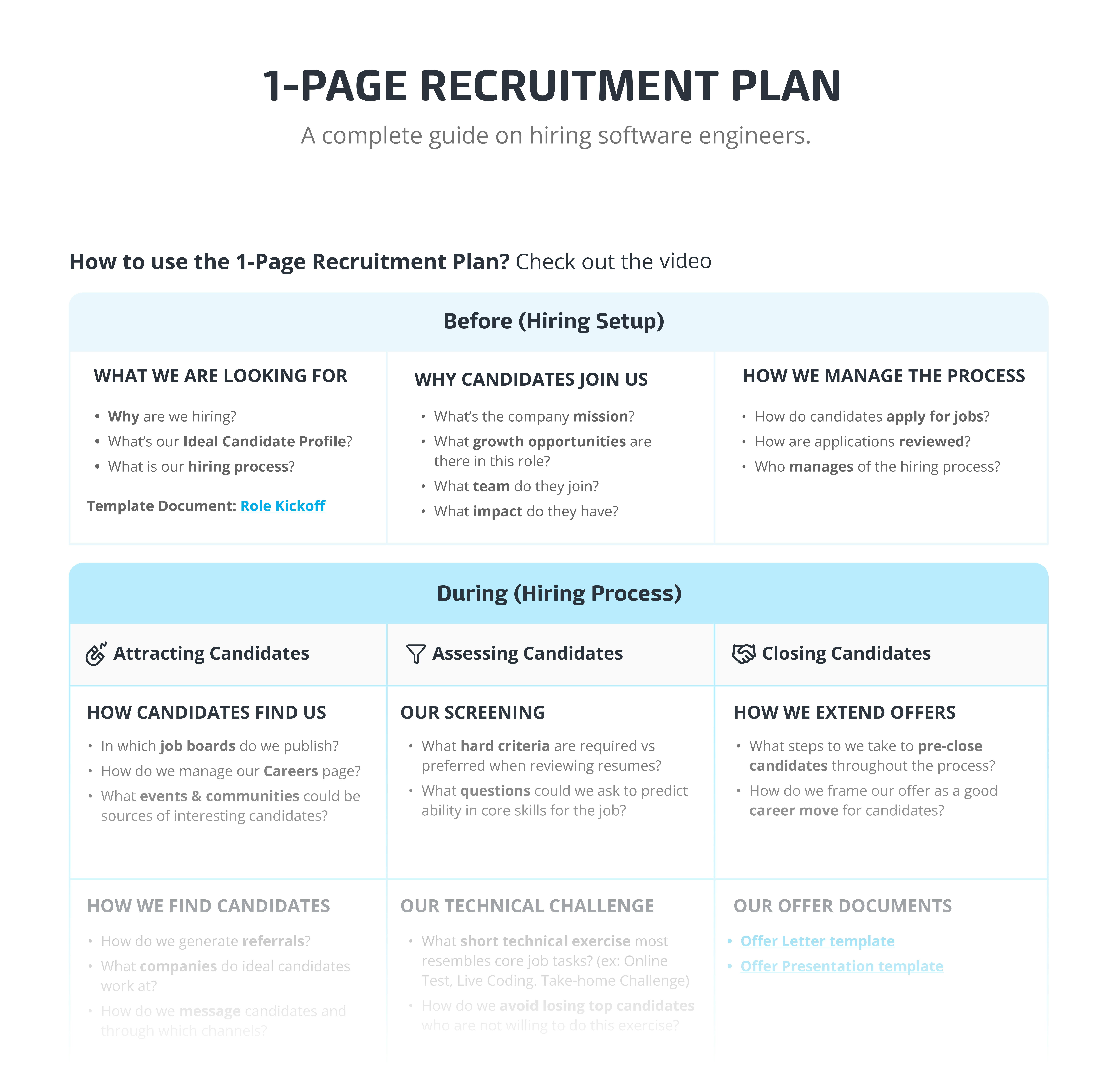
Download our free 1-page recruitment plan template and adapt it for Laravel specializations.
Understanding Laravel Developer Seniority Levels
- Junior (1-3 years): Laravel basics, Eloquent relationships, routing and controllers, Blade templates, migrations and seeders, Git workflow. Implements features with guidance.
- Mid-Level (3-5 years): Ships complete features independently. Deep Eloquent knowledge, including eager loading, N+1 prevention, and complex relationships. Understands queues and job processing, events and listeners, API authentication (Sanctum/Passport), testing with PHPUnit, and one frontend approach (Livewire OR Inertia.js OR API development).
- Senior (5+ years): Makes architectural decisions around service organization, package structure, and event-driven design. Handles complex implementations like multi-tenancy, queue optimization, and scaling strategies. Deep Laravel ecosystem knowledge (Horizon, Telescope, Nova/Filament), performance optimization, mentors junior developers, and understands trade-offs between different approaches.
Warning: 7 years of "PHP experience" could mean WordPress development with zero Laravel. 3 years modern Laravel 10+ beats 7 years generic PHP.
Salary Expectations for Laravel Developers
Laravel developers command market rates because the framework requires specific expertise beyond generic PHP skills. High demand for SaaS and web application development drives competitive compensation.
Version affects compensation significantly. Laravel 10+ developers with modern framework knowledge command standard backend developer market rates, while legacy Laravel 5.x developers may earn 10-15% less due to outdated skill sets requiring retraining. Full-stack Laravel developers with Livewire or Inertia.js expertise may command 10-15% premium over API-only backend specialists due to broader skill sets.
Region | Junior (1-3 years) | Mid-Level (3-5 years) | Senior (5+ years) | Hourly Rate |
North America | $70-90K | $90-120K | $120-160K+ | $60-90/hr |
Western Europe | $60-80K | $80-110K | $110-150K+ | $50-80/hr |
Eastern Europe | $35-50K | $50-75K | $75-110K | $30-60/hr |
Latin America | $35-50K | $50-70K | $70-100K | $30-55/hr |
Remote hiring from Eastern Europe (Poland, Romania, Ukraine) and Latin America (Brazil, Argentina, Mexico) offers strong Laravel talent pools at 40-60% of US rates with equivalent expertise and minimal time zone challenges for US companies.
How to Write a Compelling Job Description for Laravel Developers
- Specify Laravel version and frontend approach in opening line: "Laravel 10+ Developer (Livewire) - Build SaaS Application Serving 50K Users" or "Senior Laravel 11 API Developer (Sanctum) - Create RESTful API for Mobile App."
- Lead with Laravel-specific impact: "Architect Laravel 10 application with Livewire handling 1M requests/month" or "Build Laravel 11 API serving 100K mobile users with Sanctum authentication."
- Must-Have Requirements: (1) Laravel version (10+ or 11 specifically), (2) PHP version (8.1+ or 8.2+), (3) frontend approach (Livewire OR Inertia.js OR Blade OR API-only), (4) Eloquent ORM with relationship optimization, (5) queues and jobs, (6) events and listeners, (7) API authentication (Sanctum/Passport for APIs), (8) testing with PHPUnit.
- Nice-to-Have: Ecosystem tools (Horizon, Telescope, Nova/Filament), deployment (Forge, Vapor), performance (Octane), package development.
- Fatal mistake: Listing "PHP developer" without "Laravel" or "Laravel developer" without version. Laravel 5.x ≠ Laravel 10+.
- Include salary range: Transparency increases qualified applications by 40-50%.
Part 2: How to Identify the Best Laravel Developers During Hiring
Once your recruitment plan is clear, the real work begins: finding qualified Laravel developers, assessing their framework expertise, and validating their skills before making an offer.
How to Source Laravel Developers on LinkedIn
We've tried many different approaches to sourcing Laravel developers, and we've found the concentric circles method works best. Start narrow with highly specific criteria, then progressively expand only when needed.
Your initial LinkedIn search should include:
- "Laravel Developer" AND version specification ("Laravel 10" OR "Laravel 11" OR "Laravel 10+")
- Frontend approach keywords ("Livewire" OR "Inertia.js" OR "Laravel API")
- PHP 8+ mentioned in the profile or experience section
- Specific seniority level matching your requirements
- Target geographic location or remote availability
Reach out to this narrow tier first. If the pipeline runs dry, expand progressively by removing strict version requirements (accept Laravel 9+ candidates), including adjacent framework skills (Symfony developers often transition well), increasing experience range by 1-2 years, or expanding geographic radius.
Target companies using Laravel heavily: SaaS startups building products with Laravel, digital agencies specializing in Laravel development, e-commerce companies using Laravel platforms, and fintech companies with Laravel backend infrastructure.
Example outreach message: "Hi [Name], I noticed your Laravel 10 and Livewire experience at [Company]. We're building a SaaS platform serving 50K users with Laravel 11 and Livewire, looking for a mid-level developer to join our remote team. Interested in learning more about the role and tech stack?
Questions to Ask During Interviews for Laravel Developer Roles
These questions test framework-specific depth, not generic PHP knowledge:
- "Explain the N+1 query problem in Eloquent and how you prevent it in production applications" - tests Eloquent depth and performance awareness. Strong answers include eager loading with the () method, lazy eager loading, relationship preloading strategies, and real-world performance impact.
- "Walk through implementing a queue-based email sending system with job batching for 10K users" - tests async processing knowledge and scalability thinking. Strong answers cover job class structure, queue configuration, batch processing, failure handling with retries, and monitoring with Horizon.
- "How would you structure a multi-tenant Laravel application with separate databases per tenant?" - tests architectural thinking. Strong answers include tenant identification, database connection switching, middleware implementation, data isolation strategies, and migration management.
- "Describe Laravel's service container and dependency injection - when would you bind your own services?" - tests framework internals understanding. Strong answers cover automatic resolution, binding interfaces to implementations, singleton vs transient bindings, and service provider registration.
- "How would you implement real-time features in Laravel?" - tests modern Laravel features knowledge. Strong answers include Livewire for reactive components, Laravel Echo with WebSockets or Pusher, broadcasting events, polling alternatives, and trade-offs between approaches.
- "Explain the difference between Sanctum and Passport - when would you choose each?" - tests API authentication knowledge. Strong answers cover Sanctum for SPA and mobile token auth, Passport for full OAuth2 implementation, and use case appropriateness.
- "Walk through your Laravel testing strategy" - tests testing practices and quality mindset. Strong answers include Feature tests for endpoints, Unit tests for business logic, factories for test data, database transactions for test isolation, and coverage priorities.
- "How do you handle API versioning in Laravel applications?" - tests API design maturity. Strong answers include URL versioning vs header versioning, route organization, deprecation strategies, and maintaining multiple versions.
Green Flags vs Red Flags for Laravel Developers
Competency | Green Flags | Red Flags |
Laravel Version Knowledge | Confidently discusses Laravel 10/11 features and PHP 8.2+ capabilities | Stuck on Laravel 5.x-8.x with no modern version awareness |
Eloquent ORM Depth | Explains N+1 prevention, eager loading strategies, and relationship optimization | Basic CRUD operations only, unaware of performance implications |
Queue and Job Processing | Describes queue configuration, job batching, failure handling, and monitoring with Horizon | Never used queues or thinks they're just for emails |
Candidates showing 7+ green flags typically pass probation with 95%+ success rate based on Remote Crew's 150+ placements.
How to Do Technical Testing for Laravel Developers
Test under 2 hours:
- Build a simple Laravel application with 2-3 models with relationships (User, Post, Comment)
- Requirements: Laravel 10+, Eloquent relationships (one-to-many, many-to-many), API endpoints with Sanctum authentication, queue job for email sending, feature tests
- Evaluate: Laravel-specific patterns (not generic PHP), Eloquent relationship implementation with eager loading, queue and job structure, API design and authentication, testing coverage, and code organization following Laravel conventions
Alternative tests:
- Provide the existing Laravel codebase with the N+1 query problem, and implement a solution with eager loading
- Add a new feature requiring events and listeners
- Implement queue-based processing for resource-intensive tasks
Live coding alternative: 45-60 minutes implementing Laravel feature (API endpoint with relationships, queue job, event system)
General guidelines: Provide a Laravel starter project to focus on framework knowledge, test Laravel-specific patterns, not generic PHP; specify the Laravel version allowed; allow access to the Laravel documentation
Laravel Developer Skills: Complete Checklist
The difference between a Laravel developer who ships clean code and one who creates technical debt comes down to specific framework expertise, not years of PHP experience.
Must-have (Laravel 10+ Developer):
- Laravel 10+ or Laravel 11 framework expertise with modern patterns
- PHP 8.1+ or PHP 8.2+ with modern features (enums, attributes, named arguments)
- Eloquent ORM mastery (advanced relationships, eager loading, N+1 query prevention)
- Queues and job processing for async operations
- Events and listeners for event-driven architecture
- Service providers and dependency injection
- API development with Sanctum OR Passport
- Testing with PHPUnit (feature tests, unit tests, factories, seeders)
- Migrations and database seeders
- Frontend integration approach: Livewire OR Inertia.js OR Blade OR API-only (specify which you need)
Nice-to-have: - Laravel ecosystem tools (Horizon for queue monitoring, Telescope for debugging, Nova/Filament for admin panels)
- Deployment experience (Forge, Vapor, Envoyer)
- Performance optimization (Octane, caching strategies, query optimization)
- Package development, multi-tenancy implementation, WebSocket broadcasting
- Advanced testing (Dusk for browser tests, Pest, an alternative to PHPUnit)
- Soft skills critical for remote Laravel work:
- Clear async communication about technical architecture decisions
- Self-direction in debugging Laravel-specific issues
- Strong documentation habits for Laravel projects
- Proactive approach to code quality and Laravel best practices
Developers showing 7+ must-have skills typically pass probation with 95%+ success rates.
Common Mistakes When Hiring Laravel Developers
- Posting "PHP developer" instead of "Laravel Developer" - attracts WordPress developers who've never touched Laravel (70% of applicants in our experience)
- Not specifying Laravel version - "Laravel Developer" attracts developers stuck on Laravel 5.x (2015) when you need Laravel 10+ (2023-2024). These aren't interchangeable - Laravel 11 requires PHP 8.2+ with completely different patterns
- Ignoring frontend integration approach - Livewire specialist ≠ Inertia.js expert ≠ API-only backend developer. Must specify which you need
- Testing generic PHP instead of Laravel-specific knowledge - test Eloquent N+1 query prevention, queue processing, events architecture, not coding puzzles
- Treating all PHP experience equally - WordPress ≠ Laravel, Laravel 5.x ≠ Laravel 10+
- Overlooking PHP version requirement - Laravel 10+ requires PHP 8.1+, Laravel 11 requires PHP 8.2+
- Not assessing ecosystem knowledge - Horizon, Telescope, Sanctum, critical for production Laravel work
- Expecting full-stack when you need API-only (or vice versa)
- Waiting for inbound applications instead of targeted outreach - best Laravel 10+ developers with Livewire expertise aren't actively job hunting
Should You Hire Laravel Developers On-Site or Remote?
Laravel developers thrive in remote environments - the framework has a strong remote-first culture with active global communities. Here's how remote and on-site hiring compare:
Factor | Remote Hiring | On-Site Hiring |
Talent Pool Size | Global access to Laravel developers from Portugal, Eastern Europe, Latin America, Asia | Limited to local metro area with smaller Laravel community |
Cost | 40-60% lower rates in Eastern Europe and Latin America for equivalent expertise | Full US/Western Europe market rates plus office overhead |
Speed to Hire | Access pre-vetted remote Laravel networks, first candidates in 48 hours | Limited local candidates, 8-12 week average time-to-fill |
Laravel Expertise Depth | Target Laravel-heavy remote communities (strong in Poland, Brazil, Portugal, Romania) | May need to compromise on expertise level locally |
Flexibility | Asynchronous work enables deep focus for complex Laravel development | Office interruptions reduce coding productivity |
Remote hiring works exceptionally well for Laravel developers. The framework's remote-first culture, combined with strong Laravel communities in Eastern Europe and Latin America, gives you access to deeper expertise at significantly lower costs with faster hiring timelines.
The Bottom Line: Hire Modern Laravel Experts, Not Generic PHP Developers
Success in hiring Laravel developers comes down to three specifications in your job posting: framework version (Laravel 10+ or 11), frontend integration approach (Livewire/Inertia.js/Blade/API-only), and PHP version requirement (8.1+/8.2+). Then vet candidates on Laravel-specific expertise - Eloquent optimization, queue processing, events architecture - rather than generic PHP algorithms.
Companies following this framework reduce first-screening failure rates from 70%+ to under 10%, cut time-to-hire from 12+ weeks to 4-6 weeks, and achieve 95%+ probation pass rates by matching modern Laravel expertise to actual project requirements.
Remote Crew specializes in distinguishing modern Laravel 10+/11 developers from legacy PHP candidates through framework-specific vetting covering Eloquent depth, queue processing, frontend integration expertise, and ecosystem knowledge.
Book a free consultation to discuss your Laravel version and frontend approach needs - receive first pre-vetted candidates within 48 hours, no payment until you hire, 99% probation pass rate.
FAQ
What's the difference between Laravel 10+ and Laravel 5.x developers - does version really matter?
Version differences are massive. Laravel 11 (2024) requires PHP 8.2+ with modern features like enums and attributes that didn't exist in the Laravel 5.x era. The architectural patterns changed completely - modern Eloquent relationship optimization, queue batching, and testing approaches work differently. A Laravel 5.x developer hasn't touched these improvements. Retraining takes 2-3 months because they need to unlearn outdated patterns, not just learn new ones. Specify "Laravel 10+" or "Laravel 11" in every job posting to filter out legacy experience automatically.
Are Laravel developers and PHP developers the same thing?
They're completely different. PHP is the language - Laravel is a specific framework requiring dedicated expertise. Post "PHP developer" and you'll get WordPress theme builders and procedural PHP programmers with zero Laravel knowledge. Laravel developers must understand Eloquent ORM, service container dependency injection, queues, events, and middleware architecture. Someone with 5 years of PHP experience could have spent all of it on WordPress sites. Always write "Laravel Developer (Laravel 10+)" in requirements, never generic "PHP developer."
Should I hire for Livewire, Inertia.js, or Blade - which frontend approach is best?
Choose based on your project and team. Livewire keeps everything in PHP/Laravel - perfect for backend teams building reactive SaaS interfaces without JavaScript frameworks. Inertia.js pairs Laravel with Vue or React for a modern SPA experience when you want JavaScript frontend power. Blade templates work for content-heavy sites with server-side rendering. An API-only approach fits mobile apps or separate frontend frameworks. Developers specialize in one approach - a Livewire expert doesn't automatically know Inertia.js. Specify your stack in the job posting upfront.
What should Laravel developers earn in 2026?
Modern Laravel 10+ developers earn standard backend rates by region. North America: junior $70-90K, mid-level $90-120K, senior $120-160K+. Eastern Europe: junior $35-50K, mid-level $50-75K, senior $75-110K. Latin America: junior $35-50K, mid-level $50-70K, senior $70-100K. Full-stack developers with Livewire or Inertia.js expertise command 10-15% premiums over API-only specialists. Remote hiring from Eastern Europe or Latin America delivers 40-60% cost savings versus US rates for equivalent skills.
What's the best country to hire remote Laravel developers in 2026?
Eastern Europe and Latin America offer the strongest value. Poland, Romania, and Ukraine have established Laravel communities with strong technical education at 40-50% lower rates than US developers. Brazil, Argentina, and Mexico provide excellent talent with minimal time zone differences for US companies and 40-60% cost savings. Portugal is emerging as a Laravel hub with good English proficiency and EU timezone compatibility. Remote Crew specializes in pre-vetted Laravel developers from these regions with framework-specific screening covering Eloquent optimization, queue processing, and Laravel 10+/11 expertise.
Tech hiring insights in your inbox
From engineers to engineers: helping founders and engineering leaders hire technical talent.
We will only ever send you relevant content. Unsubscribe anytime.