

Most companies when hiring for remote developers, post "mobile app developer" jobs and waste weeks interviewing candidates who'll never work out. They interview iOS experts for Android roles, or hire web developers who built one React Native tutorial but never deployed to App Stores.
The "mobile app developer" isn't one role. It covers iOS Swift specialists, Android Kotlin developers, React Native cross-platform engineers, and Flutter developers - fundamentally different skill sets with zero interchangeability.
At Remote Crew, we analyzed 10,000+ developer interviews and placed 250+ developers. The patterns separating successful hires from expensive mistakes are clear.
This guide gives you the decision framework for native vs cross-platform, mobile-specific interview questions that work, app store deployment verification methods, 2026 salary benchmarks, and a structured process that prevents costly mistakes.
Key Takeaways for Hiring Mobile Developers
- Mobile app developer is not one role: iOS Swift specialists, Android Kotlin developers, React Native engineers, and Flutter developers require completely different skill sets with zero interchangeability, so specify exactly one platform in job descriptions.
- Choose native iOS or Android when you need platform-specific features or target specific markets (iOS for premium North America/Europe at $110K-180K, Android for emerging markets with 70-72% global share), but expect to hire two separate developers for both platforms.
- Cross-platform React Native or Flutter cuts costs 40-60% by hiring one developer for both iOS and Android, performs well for 90% of apps, and accelerates MVPs from 20-28 weeks to 12-16 weeks with minimal performance trade-offs.
- Preparation determines 80% of hiring success: create a one-page recruitment plan stating your platform decision first, required frameworks, app store deployment experience, and specific device integrations before posting jobs or interviewing candidates.
When Do You Need Mobile App Developers
- Building native iOS or Android applications requiring platform-specific features
- Developing cross-platform apps for both iOS and Android from single codebase
- Creating apps requiring device features (camera integration, GPS location services, push notifications, biometric authentication)
- Building offline-first mobile experiences with local data sync
- Maintaining existing mobile applications (performance optimization, OS version updates, new features)
- Migrating web applications to mobile platforms with native device integration
Native vs Cross-Platform - Which Mobile Developer Do You Need?
The biggest decision you'll make is choosing between native and cross-platform development. This choice determines everything: which developers you hire, your budget, and your timeline.
Native iOS Developer (Swift + SwiftUI/UIKit)
- Builds apps exclusively for iPhone/iPad using Swift and Apple's frameworks
- Works with Xcode, SwiftUI or UIKit, handles App Store deployment through TestFlight
- Right for: iOS-only products, cutting-edge Apple features (ARKit, advanced Core ML, WidgetKit), maximum performance optimization, premium markets in North America and Western Europe
- Trade-off: $110-125K annually in US (senior $135-180K), 5-10% smaller talent pool than Android due to Mac requirement
Native Android Developer (Kotlin + Jetpack Compose)
- Builds exclusively for Android devices using Kotlin and Google technologies
- Works with Android Studio, Jetpack Compose or XML layouts, deploys through Google Play Console
- Right for: Emerging markets where Android holds 70-72% global market share, deep Android platform integration
- Advantage: Strong Android expertise in Eastern Europe, Latin America, and Asia provides cost-effective remote hiring
Cross-Platform Developer (React Native)
- Writes one JavaScript/TypeScript codebase deploying to both iOS and Android
- Needs React framework knowledge plus understanding of both platforms
- Right for: Teams with JavaScript knowledge, building alongside React web app, rapid development with mature ecosystem
- Cost advantage: Hire one developer instead of two native developers for 40-60% savings
- Performance: Hits 51 FPS, suits 90% of mobile apps
Cross-Platform Developer (Flutter)
- Writes one Dart codebase deploying to iOS, Android, web, and desktop
- Holds approximately 46% cross-platform market share, excels at pixel-perfect UI consistency
- Right for: MVPs (12-16 weeks vs 20-28 weeks for separate native apps), performance-critical apps with complex animations, products expanding beyond mobile
- Cost advantage: Same 40-60% savings as React Native
- Caveat: Dart has a 2-3 week learning curve, a smaller talent pool than JavaScript
Decision Framework
Approach | Primary Language | Platforms | Development Cost | Best Use Cases |
Native iOS | Swift | iOS only | High (1 developer) | iOS-exclusive features, premium markets |
Native Android | Kotlin | Android only | High (1 developer) | Android-first strategy, emerging markets |
React Native | JavaScript/TypeScript | iOS + Android | Medium (1 developer, both platforms) | JavaScript teams, rapid development, 90% of apps |
Flutter | Dart | iOS + Android + Web | Medium (1 developer, multiple platforms) | Pixel-perfect UI, MVPs, multi-platform expansion |
Warning: Never require iOS AND Android AND React Native expertise equally in job descriptions. These are distinct specializations. Specify exactly one: "iOS Developer (Swift)" OR "Android Developer (Kotlin)" OR "React Native Developer" OR "Flutter Developer." Requiring all three filters out 99% of qualified candidates.
Three Stages of Hiring Mobile App Developers
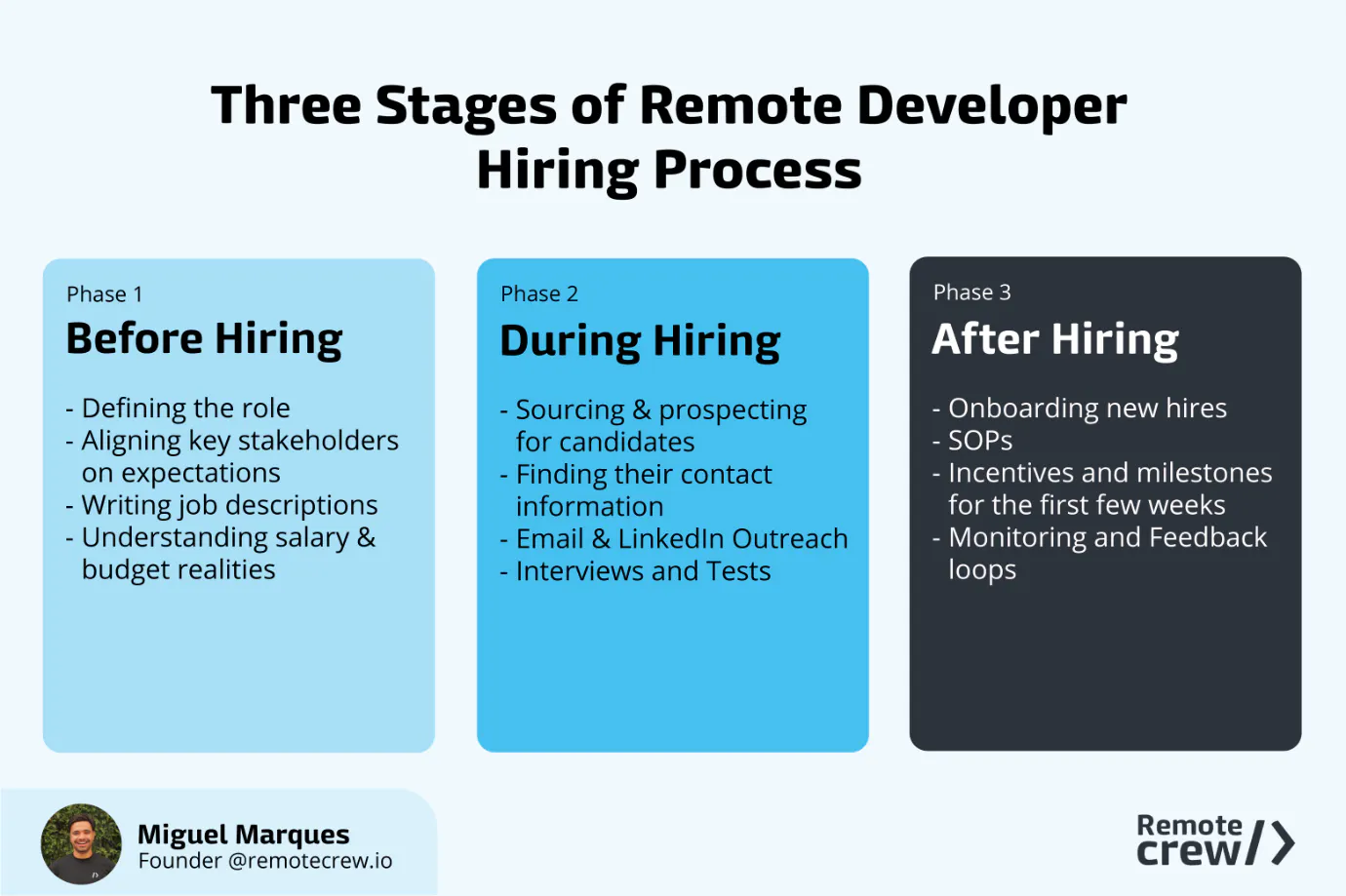
Most companies jump straight to interviewing candidates and wonder why they waste weeks on misaligned hires. Mobile developer hiring requires three phases: Before, During, and After.
- Phase 1 - Before Hiring prevents 80% of failures through role definition, platform decision (native vs cross-platform), salary budgeting, and stakeholder alignment.
- Phase 2 - During Hiring focuses on sourcing mobile specialists on LinkedIn, structured interviews with platform-specific questions, and technical tests under 2 hours that validate app store deployment experience.
- Phase 3 - After Hiring covers onboarding and early success.
The following sections break down Phases 1 and 2 with mobile-specific playbooks.
Part 1 - What You Need to Do Before Hiring Mobile App Developers
The preparation phase determines 80% of your hiring success. Get this wrong, and you'll interview dozens of misaligned candidates. Get it right, and you'll hire in weeks instead of months.
Create Your 1-Page Recruitment Plan for Mobile App Developers
We've found that the best mobile developer hires start with a single-page document that forces clarity before you write a job post or reach out to anyone.
- Business Problem: State your platform decision explicitly. Write "Building native iOS fitness app with HealthKit integration serving 50K users" or "Creating cross-platform e-commerce app with Stripe payment processing for iOS and Android" - not "mobile app needed."
- Platform Decision First: This is the most important decision you'll make because it determines everything else. Native iOS + Android requires two separate hiring processes and two completely different recruitment plans. Cross-platform (React Native or Flutter) requires one plan, but you must specify which framework explicitly.
- Here's the critical part: Your must-haves should include platform decision FIRST (iOS/Android/Cross-platform), specific framework (Swift + SwiftUI, Kotlin + Jetpack Compose, React Native, Flutter), app store deployment experience for your target platform(s), and device feature integration experience (camera, GPS, push notifications, biometric auth).
- Why They'd Join: Mobile developers value seeing their work on user devices worldwide. Highlight your app's impact with actual numbers (download counts, user metrics), mobile-specific challenges they'll solve (offline sync, push notifications, camera integration), and a clear growth path like "lead mobile architect within 18 months."
Get a free 1-page recruitment plan template from our website to kickstart this process.
Understanding Mobile App Developer Seniority Levels
- Junior (1-3 years): One platform basics (iOS OR Android OR React Native OR Flutter), implements UI screens and simple features with guidance, integrates RESTful APIs, basic device features (camera, location) following documentation, simulator/emulator testing
- Mid (3-5 years): Ships complete apps independently to app stores, deep app store deployment experience (TestFlight/App Store Connect for iOS, Play Console for Android, both for cross-platform), implements platform-specific features (push notifications, biometric auth, deep linking, background processing), optimizes mobile performance (app size, battery drain, 60 FPS scrolling), offline-first architecture with local database sync, real device testing across multiple OS versions
- Senior (5+ years): Mobile architecture decisions (navigation patterns, state management, data persistence), complex integrations (payments, OAuth, WebSocket, geofencing), shipped apps with 10K+ downloads, deep expertise in both platforms (native) OR deep cross-platform expertise with platform-specific modules, performance optimization (profiling, memory leaks, app size reduction), app store optimization (metadata, A/B testing, review strategies), mentors junior developers
- Warning: Web developer with 5 years who built one React Native tutorial is NOT a mobile developer - mobile requires platform-specific knowledge (app store processes, device features, mobile performance) web doesn't teach
Salary Expectations for Mobile App Developers
Mobile developers command premiums over web developers for good reason: specialized platform knowledge, a smaller talent pool, and app store deployment expertise that takes years to develop.
Platform choice affects your rates significantly. iOS developers command a 5-10% premium due to Mac requirements and a smaller talent pool. Android rates are comparable to other development specialties. Cross-platform developers (React Native, Flutter) command a 10-15% premium because they handle both platforms.
Here's what you can expect to pay for mobile developers:
Region | Junior | Mid-Level | Senior | Hourly Rate |
North America | $60-80K | $90-130K | $130-180K | $100-150/hr |
Western Europe | $45-65K | $70-100K | $100-140K | $80-120/hr |
Eastern Europe | $30-45K | $45-70K | $65-95K | $50-80/hr |
Latin America | $25-40K | $40-60K | $55-85K | $40-70/hr |
Eastern Europe and Latin America offer strong mobile talent - especially Android developers - at 40-60% of US rates while delivering comparable quality. Global app distribution means quality is consistent regardless of developer location.
How to Write a Compelling Job Description for Mobile App Developers
Specify platform in your opening line: "iOS Developer (Swift + SwiftUI) - Build health tracking app serving 100K users with HealthKit integration" NOT "Mobile App Developer Needed."
Lead with platform-specific impact: "Architect offline-first sync for iOS fitness app handling 50K daily users, integrating HealthKit, CloudKit, and push notifications."
Must-Have Requirements:
- Platform and framework: iOS Swift + SwiftUI, Android Kotlin + Jetpack Compose, React Native TypeScript, OR Flutter Dart
- App store deployment experience: TestFlight + App Store Connect (iOS) or Play Console (Android) or BOTH for cross-platform
- Device feature integration: Camera, GPS, push notifications, biometric auth
- Background processing and offline sync
- Platform design patterns
Nice-to-Have:
- Advanced platform features: ARKit, ML Kit, HealthKit
- Deep linking
- Third-party SDK integration: Firebase, analytics, crash reporting
- CI/CD for mobile: Fastlane, Bitrise
- Performance optimization
Specify EXACTLY which platform: "iOS Developer (Swift)" OR "Android Developer (Kotlin)" OR "React Native Developer" OR "Flutter Developer" - one only. Never list iOS/Android/React Native/Flutter as interchangeable or require equal expertise in multiple platforms.
Include salary range - mobile developers have options and skip roles without transparent compensation. Highlight mobile-specific benefits: opportunity to see work on millions of devices, mobile-specific technical challenges, app store presence with immediate user feedback, and a growth path to mobile architect.
Part 2 - During Hiring - How to Identify the Best Mobile App Developers
Most companies post jobs and wait for applications. That's the wrong approach. The best mobile app developers aren't browsing job boards - they have recruiters reaching out constantly. When they're ready to move, they simply start responding to messages.
If you're not doing outreach, your competitors are contacting your ideal candidates first.
How to Source Mobile App Developers on LinkedIn
We've tried many different ways to find and reach ideal candidates, and the concentric circles method works best because it prevents strong candidates from getting buried in massive lists you never reach due to time constraints.
Start narrow with exact criteria: job title filters ("iOS Developer" OR "Swift Developer", "Android Developer" OR "Kotlin Developer", "React Native Developer", "Flutter Developer"), platform-specific frameworks in skills (Swift + SwiftUI, Kotlin + Jetpack Compose, React Native + TypeScript, Flutter + Dart), app store deployment mentioned (TestFlight, App Store Connect, Play Console), seniority level, and location. Reach out to this tier first.
Then expand progressively. Remove the app store requirement, increase the experience range, expand geography, and add adjacent skills like iOS developers with Objective-C transitioning to Swift, or React web developers exploring React Native.
Portfolio verification is critical. Check GitHub for mobile repositories with Swift files, Kotlin files, or React Native/Flutter projects. Verify App Store or Play Store links to published apps proving deployment experience. Look for mobile open-source contributions.
Your outreach message must be short - under 300 characters for LinkedIn. Include specific mobile work you noticed, a concrete technical challenge, and salary upfront.
Example: "Hi Maria - saw your React Native payment integration work at Stripe. We're building similar checkout flow for cross-border e-commerce, your biometric auth + secure payment experience directly relevant. $120-140K + equity, fully remote, both iOS and Android deployment. Worth a quick chat? [link]"
What Questions to Ask During the Interview for a Mobile App Developer Role
Use structured questions that generate technical discussion rather than right/wrong answers. We've found these questions reveal depth of experience most reliably:
- "Walk through app store submission process for your platform" - tests real deployment experience versus simulator-only developers. Strong candidates explain provisioning profiles, code signing certificates, TestFlight or App Store Connect for iOS, or signing keys, release tracks, and Play Console for Android.
- "Native vs cross-platform - when to choose each?" - tests architectural judgment and platform understanding. Strong answers explain native for performance-critical apps and platform-specific features versus cross-platform for rapid launch, limited budget, and consistent UI.
- "How do you handle offline functionality in mobile apps?" - tests mobile-specific architecture. Strong answers discuss local database options like Core Data or Realm for iOS, Room or SQLite for Android, AsyncStorage for React Native, or Hive for Flutter, plus sync strategies, conflict resolution, and background sync.
- "Describe push notification implementation on your platform" - tests platform-specific feature integration. iOS developers discuss APNs certificates, device tokens, and notification service extensions. Android developers explain FCM integration, notification channels, and importance levels.
- "How do you optimize mobile app performance?" - tests mobile-specific constraints. Strong answers address app size reduction, battery optimization, memory management, and maintaining 60 FPS. Web developers give generic answers.
- "Walk through debugging a crash on specific devices" - tests real mobile debugging experience. Strong candidates discuss symbolication, reproducing on specific OS versions or devices, platform debugging tools, and device-specific issues.
Green Flags vs Red Flags for Mobile App Developers
Category | Green Flags | Red Flags |
Platform Expertise | Deep knowledge of a specific platform (Swift + iOS SDK OR Kotlin + Android SDK), explains platform patterns, aware of the latest updates | Claims equal expertise in iOS AND Android AND React Native, unfamiliar with current versions |
App Store Experience | Detailed TestFlight/Play Console discussion, explains provisioning/code signing, familiar with review guidelines | Never shipped to production stores, vague about deployment, no beta testing experience |
Device Features | Implemented camera, GPS, push notifications, biometric auth, and explains platform permissions | Only basic API integration, no device-specific features, unfamiliar with permissions |
In our experience, candidates showing 7+ green flags are the ones who go on to pass probation.
Additional green flags:
- Discusses app size optimization, battery reduction, memory profiling, 60 FPS maintenance, and offline sync strategies
- Tests on multiple real devices, aware of device-specific bugs, tests across OS versions
- Understands iOS HIG or Material Design, implements platform-appropriate navigation, and follows platform conventions
Additional red flags:
- Treats mobile like a web app, no awareness of device constraints, never profiled performance
- Only simulator/emulator testing, unaware of real device differences
- Identical UI for both platforms ignoring conventions, non-standard navigation patterns
How to Do Technical Testing for Mobile App Developers
Testing is non-negotiable - it's the highest-signal predictor of job performance.
Sample tests (under 2 hours):
- Build a simple 2-3 screen app with API integration and local data persistence (fetch from API, display in list with loading/error states, persist locally for offline, pull-to-refresh)
- Implement device feature with permissions (camera with image capture/preview, location with map, push notification registration)
- Create UI following platform guidelines with navigation
Evaluate platform-specific code quality (Swift optionals, Kotlin null safety, React Native async, Flutter state management), UI following platform guidelines (iOS HIG or Material Design), API integration with error handling, local data persistence (Core Data, Room, AsyncStorage, Hive), permission handling, and code organization.
Provide a starter project template when possible with an API endpoint configured, a basic project structure with dependencies, and a placeholder UI. This focuses on mobile implementation, not project setup.
Real device testing requirement: The candidate must test on a real iPhone or Android device, not just a simulator. This validates device-specific behavior understanding.
Modern developers use AI tools in their daily work. Focus on whether they can explain code choices and architectural decisions during the review call. Live coding is an alternative - a 45-60 minute session implementing a feature while explaining their approach.
Mobile App Developer Skills - Complete Checklist
Mobile developer skills vary dramatically by platform choice - hiring for the wrong specialization wastes weeks. Here's what matters.
Must-have skills for mid-level and above:
- Platform expertise: Swift + SwiftUI/UIKit (iOS) OR Kotlin + Jetpack Compose (Android) OR React Native + TypeScript OR Flutter + Dart - pick exactly one
- Platform UI implementation following iOS Human Interface Guidelines OR Material Design patterns
- RESTful API integration with async handling, error management, and authentication flows
- Local data storage: Core Data/Realm (iOS), Room/SQLite (Android), AsyncStorage (React Native), or Hive (Flutter)
- App store deployment experience: TestFlight + App Store Connect (iOS) or Play Console (Android) - non-negotiable
- Device features: camera permissions, GPS location, push notifications (APNs/FCM), biometric authentication
- Platform debugging tools and Git workflow
Nice-to-have skills:
- Both iOS and Android for native developers who expanded platform knowledge
- CI/CD automation: Fastlane, Bitrise
- Firebase/AWS Amplify integration
- Third-party SDK experience
Soft skills critical for remote:
- Clear async communication about mobile-specific concepts
- Self-direction in debugging device-specific issues
- Proactive testing across multiple devices and OS versions
Common Mistakes When Hiring Mobile App Developers
After analyzing 10,000+ interviews, these mistakes consistently derail mobile hiring:
- Posting a generic "mobile app developer" without a platform specification. You'll attract iOS specialists for Android roles, React Native developers for native positions, and waste 60+ hours reviewing misaligned candidates. Always specify: "iOS Developer (Swift)" OR "Android Developer (Kotlin)" OR "React Native Developer."
- Expecting iOS + Android + React Native expertise equally. These are fundamentally different specializations with different tools and workflows. Requiring all three filters out 99% of qualified candidates. Mobile developers specialize in ONE platform deeply.
- Not requiring app store deployment experience. Developers without TestFlight or Play Console experience lack crucial knowledge - provisioning profiles, code signing, app review guidelines, and release management. This missing knowledge causes onboarding failures.
- Hiring web developers claiming mobile experience. React developers aren't automatically React Native developers. Web performance optimization differs completely from mobile. App store deployment knowledge is entirely absent.
- Testing only on simulators. Simulator testing misses device-specific bugs, memory constraints, actual camera behavior, and real network conditions.
- Waiting for applications instead of outreach. Best mobile developers respond to recruiter messages - they don't browse job boards.
Mobile App Developer Hiring Checklist
After analyzing 10,000+ developer interviews, here's the essential checklist that separates successful hires from costly mistakes.
Before Hiring
- Create a 1-page recruitment plan specifying iOS OR Android OR React Native OR Flutter explicitly
- Decide platform first: Native (two developers for iOS + Android) or cross-platform (one developer for both)
- Set a realistic budget with the platform premium factored in
- Write a platform-specific job description with a salary range and required platform expertise
During Hiring
- Conduct market mapping: mobile-first companies, app development agencies
- Build candidate lists using concentric circles with platform-specific filters (Swift, Kotlin, React Native, Flutter)
- Verify portfolio: Check App Store or Play Store links to published apps
- Ask platform-specific technical questions during interviews
- Verify app store deployment: Can they explain TestFlight or Play Console in detail?
- Require real device testing, not just simulator work
- Meet 4-5 qualified candidates before deciding
After Hiring
- Prepare mobile-specific documentation: platform guidelines, app store processes, device provisioning workflows
- Set up development environment: Apple Developer account (iOS) or Google Play Console (Android)
- Assign a mobile-focused onboarding buddy
- Define 60-day milestones: first app store build, first TestFlight beta, first production release
Should You Hire Mobile App Developers On-Site or Remote?
Remote wins for 90% of mobile app hiring. The global talent pool gives you 100x more specialists, faster hiring, and significant cost savings without quality trade-offs.
Criteria | Remote Mobile Developers | On-Site Mobile Developers | Why It Matters for Mobile |
Talent Pool | Global millions | Local thousands | 100x more iOS/Android/React Native/Flutter specialists |
Platform Specialization | Find an exact platform match globally | Limited by the local market | Access specific framework experts easily |
Cost (Senior) | $60K-70K | $120K-140K US | 40-60% savings, 2x team at the same budget |
Device Testing | Developers provide their own devices | The company provides test devices | Remote devs often have personal device collections |
Time to Hire | 48 hours first candidates | 2-4 weeks local | Faster remote sourcing, faster shipping |
Mobile development works exceptionally well remotely because app stores are globally accessible, and platform expertise is distributed worldwide.
Android talent is particularly strong in Eastern Europe and Latin America. iOS developers thrive across Europe and remote-first markets.
Let the Experts Find the Best Mobile App Developers for You
If parsing iOS specialists, Android developers, and React Native experts sounds exhausting, Remote Crew handles the entire process through pre-vetted networks in Europe and Latin America.
We distinguish platform expertise precisely: iOS developers with Swift and TestFlight deployment experience, Android developers with Kotlin and Play Console knowledge, and React Native developers with cross-platform capabilities.
Our screening tests app store deployment, device feature integration (camera, GPS, push notifications, biometric auth), and reviews published portfolios in actual app stores.
Speed matters. You'll see your first qualified mobile developer within 48 hours from platform-specific networks, not generic talent pools.
Results? 96% of our permanent hires since 2022 stayed beyond the 90-day guarantee, 90%+ first screening pass, 60% reduction in time-to-hire, and access to mobile talent at 40-60% of US rates.
You won't pay anything until we deliver the right candidate.
Book a free consultation to discuss your platform needs (iOS, Android, or cross-platform) and get matched with pre-vetted candidates in 48 hours.
FAQ
What is the difference between native and cross-platform mobile developers?
Native developers specialize in one platform - iOS with Swift OR Android with Kotlin - building apps exclusively for that ecosystem using platform-specific tools. Cross-platform developers use React Native (JavaScript) or Flutter (Dart) to write one codebase that deploys to both iOS and Android. The key difference: native requires two separate developers for both platforms versus one cross-platform developer. Native provides maximum performance and full platform feature access. Cross-platform delivers 40-60% cost savings and faster time-to-market. Choose native for performance-critical apps or a single-platform strategy. Choose cross-platform for startups, MVPs, or limited budgets needing both platforms quickly.
What is the average mobile app developer salary in 2026?
US markets average $110K-125K for mobile developers, with iOS commanding 5-10% premium and cross-platform developers earning 10-15% more for dual-platform capability. Eastern Europe and Latin America offer 40-60% cost savings at $45K-70K for mid-level developers while maintaining comparable quality. App store deployment experience adds a 10% premium - developers without production shipping experience lack crucial mobile knowledge. Senior developers with specialized skills (AR, ML integration, complex animations) command $135K-180K in US markets or $60K-90K in cost-effective remote regions.
Should I hire an iOS, Android, or cross-platform mobile developer?
Choose iOS if targeting the US, Canada, and Western Europe, where iOS dominates premium markets and generates higher revenue per user. Choose Android if targeting global markets, emerging economies, or regions where Android holds 70-72% market share. Choose cross-platform (React Native or Flutter) if you need both platforms with a limited budget, startup speed requirements, or a small team. Cross-platform delivers both iOS and Android with one developer at 40-60% cost savings versus two separate native developers. 90% of mobile apps don't require native performance, so cross-platform works for most use cases.
What is the best country to hire remote mobile app developers from?
Portugal and Eastern Europe provide strong mobile talent with solid iOS and especially strong Android expertise at 40-60% below US rates. Latin America (Brazil, Argentina, Chile, Mexico) offers excellent developers with a favorable time zone overlap for US companies and similar cost savings. Both regions produce quality developers because app stores enforce global quality standards, making mobile development truly location-independent. Android developers are particularly strong in Eastern Europe, Latin America, and Asia due to Android market dominance in those regions. Choose based on time zone overlap requirements and platform specialization needs.
How long does it typically take to hire a mobile app developer?
Phase 1 Preparation takes 3-5 days for platform decision and role definition. Phase 2 Sourcing takes 1-2 weeks, with the first LinkedIn responses in 48 hours. Phase 3 Screening takes 1-2 weeks for technical screening and app store deployment verification. Phase 4 Interviews and Testing takes 2-3 weeks for structured interviews and under-2-hour technical tests. Phase 5 Offer and Onboarding takes 1-2 weeks for negotiation and notice period. The total efficient timeline is 6-10 weeks from platform decision to start date, with a structured approach. Remote Crew delivers first candidates in 48 hours and completes typical placements in 4-6 weeks through pre-vetted platform-specific networks.
Tech hiring insights in your inbox
From engineers to engineers: helping founders and engineering leaders hire technical talent.
We will only ever send you relevant content. Unsubscribe anytime.