

Post a "Python developer" job, and you'll receive applications from three completely different specializations: backend web developers building Django APIs, data scientists analyzing datasets in Jupyter notebooks, and ML engineers deploying PyTorch models to production. Same language, incompatible skill sets.
The result? Companies waste weeks interviewing wrong remote developers, data scientists, for backend API roles, hiring Flask developers for ML engineering positions who've never worked with deep learning frameworks, or rejecting qualified candidates because job requirements mix Backend + Data Science + ML Engineering into a single impossible unicorn role.
At Remote Crew, we've hired 250+ developers and interviewed 10,000+ candidates across Backend (Django/Flask/FastAPI), Data Science (pandas/scikit-learn), and ML Engineering (PyTorch/TensorFlow) specializations.
This guide distinguishes these three paths with framework-specific hiring strategies, specialization-matched interview questions, and technical tests that validate the right skills. Following this framework reduces time-to-hire from 12-16 weeks to 6-10 weeks.
Key Takeaways
Python hiring fails when companies treat it as one role. It isn't. There are three specializations that don't overlap:
- Backend developers build web applications and APIs with Django, Flask, or FastAPI
- Data Scientists analyze datasets using pandas and SQL
- ML Engineers deploy PyTorch and TensorFlow models to production with MLOps practices
A backend developer can't do data science work. A data scientist doesn't know web frameworks. ML engineers need a different skill set from both. Posting a generic "Python developer" role pulls in 80% mismatched candidates, and companies that skip the upfront definition waste 20+ hours on interviews that go nowhere.
The fix is a 1-page recruitment plan covering your business problem, framework requirements, and one specialization. Two or three hours of work here drops time-to-hire from 12–16 weeks to 6–10 weeks.
A few things that move the needle:
- Framework-specific job titles. Replace "Python Developer" with "Backend Python Developer building Django REST APIs," or "Data Scientist with pandas + SQL," or "ML Engineer deploying PyTorch models with MLOps monitoring."
- Framework specificity in screening. Django, Flask, and FastAPI developers are not interchangeable. Different patterns, different ORMs, different architecture. Three years of Django beats seven years of generic "Python web development."
- Modern stack assumptions. Python 3.9+ baseline (Python 2 sunset in 2020), async/await for backend performance, type hints increasingly standard.
Ready to hire the right Python specialist? Book a free consultation with Remote Crew and get your first qualified candidates within 48 hours.
When Do You Need Python Developers
You need Python developers when you're building backend web applications and RESTful APIs. Django works for full-featured web apps with admin panels and ORM. Flask fits lightweight microservices and API-first projects. FastAPI delivers modern async APIs with automatic documentation and type safety.
Beyond backend work, Python developers fill three distinct specializations:
- Data Science roles for processing business data with pandas, running A/B tests, customer segmentation, and generating insights from datasets using SQL + Python. They build predictive models with scikit-learn.
- ML Engineering roles for building recommendation systems, computer vision applications, and NLP models. These require both ML knowledge (PyTorch/TensorFlow) and production deployment skills (MLOps, monitoring, serving).
- DevOps and data engineering for infrastructure as code, CI/CD pipelines, automation scripts, ETL workflows, and data processing pipelines with Airflow or Spark.
The specialization you need determines everything about your hiring process.
Defining a Python Developer for Your Company
Here's the problem: post "Python developer" and you'll receive applications from backend web developers who build Django APIs, data scientists who analyze datasets in pandas, and ML engineers who deploy PyTorch models. Same programming language, completely incompatible skill sets.
We've interviewed 10,000+ candidates across these specializations, and the companies that hire successfully make one decision first: Backend vs Data Science vs ML Engineering. Only then do they specify the framework.
Backend Python Developer (Django/Flask/FastAPI)
Backend Python developers build web applications, REST APIs, and server-side business logic for production systems serving thousands to millions of users. They handle authentication, database design, API endpoints, and async operations.
- Tech stack: Django (batteries-included framework with ORM and admin panels), Flask (lightweight microservices), or FastAPI (modern async with automatic OpenAPI docs). They work with PostgreSQL, MongoDB, or Redis for data storage and understand async programming with asyncio and async/await syntax.
- Right for: Building SaaS web applications, microservices architectures, RESTful APIs consumed by frontend apps, authentication systems, and database-backed CRUD applications.
- Example job title: "Backend Python Developer building Django REST APIs serving 100K daily users with PostgreSQL and Redis caching."
Data Scientist (pandas/scikit-learn/statistics)
Data scientists analyze business data, build statistical models, create visualizations, and generate actionable insights from datasets. They communicate findings to non-technical stakeholders and work primarily in notebooks for analysis and reporting.
- Tech stack: pandas for data manipulation, NumPy for numerical computing, scikit-learn for classical ML models, Jupyter notebooks for exploratory analysis, SQL for data querying, matplotlib, and seaborn for visualization.
- Different from backend: May have zero Django, Flask, or FastAPI knowledge. No experience with async Python or API design. They're not building production web applications.
- Example job title: "Data Scientist analyzing e-commerce customer behavior with Python (pandas + SQL) for personalization and churn prediction."
ML Engineer (PyTorch/TensorFlow/MLOps)
ML engineers train custom machine learning models and deploy them to production systems at scale. They handle model versioning, monitoring, and retraining pipelines with engineering rigor that data scientists often lack.
- Tech stack: PyTorch or TensorFlow, MLOps practices (model deployment, A/B testing, monitoring for drift), feature engineering pipelines, model serving infrastructure, cloud ML platforms like AWS SageMaker.
- Different from data scientists: Focus on production deployment and engineering practices - testing, CI/CD, monitoring, error handling. Different from backend developers: Focus specifically on ML systems, not general web application development.
- Example job title: "ML Engineer deploying PyTorch recommendation models serving 50K predictions/second with MLOps monitoring and A/B testing."
Critical: Specify exactly ONE specialization in your job posting - "Backend Python Developer (Django)" OR "Data Scientist (Python + pandas + SQL)" OR "ML Engineer (PyTorch + MLOps)." Posting a generic "Python developer" attracts all three types, with 80% wrong specialization matches.
The Three Stages of Hiring Python Developers
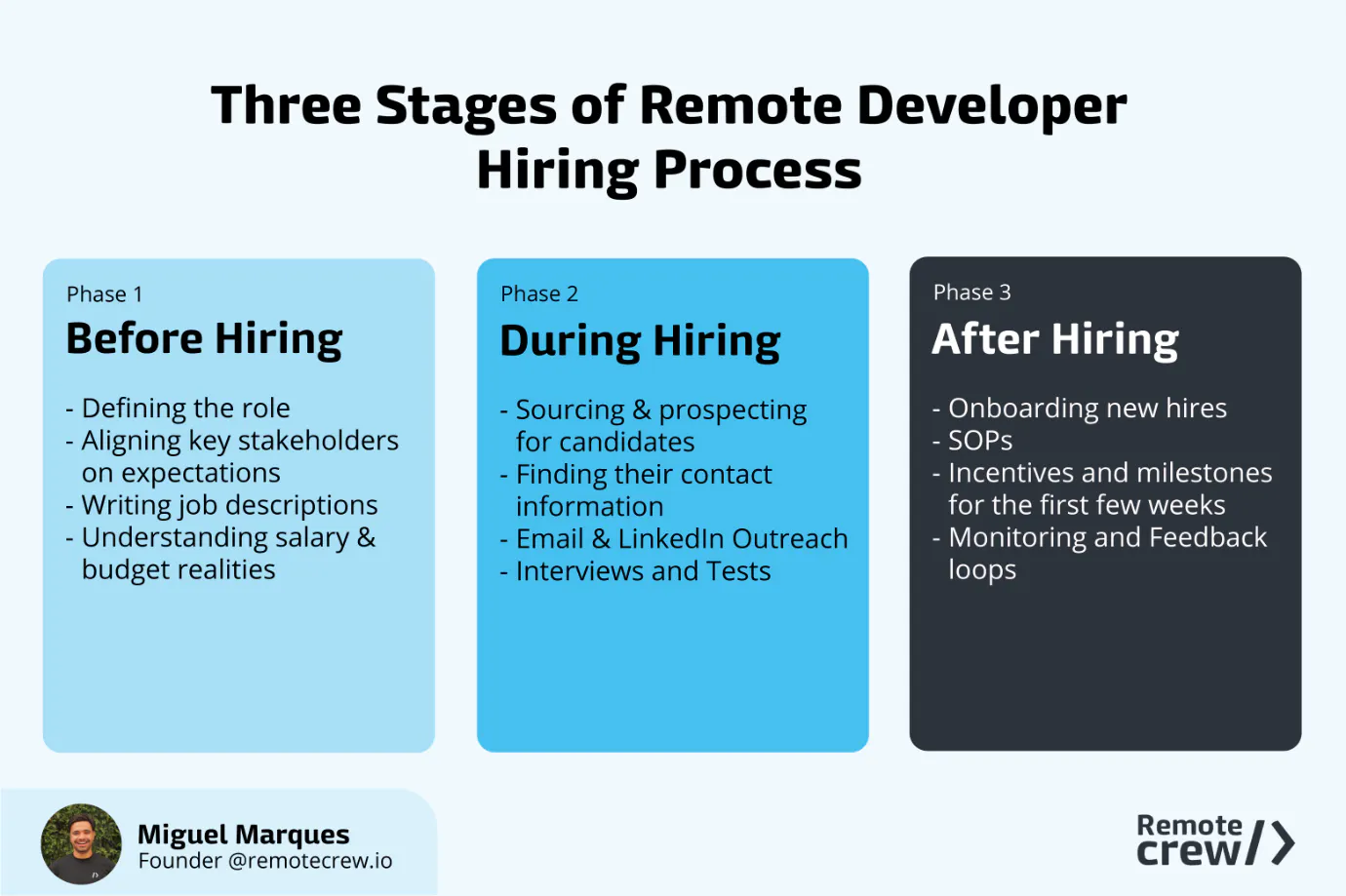
- Phase 1 - Before Hiring determines 80% of success. Define your specialization: Backend Django developer, Data Scientist with pandas, or ML Engineer with PyTorch. Create a role kickoff specifying framework requirements and salary realities (ML Engineers command 20-40% premiums).
- Phase 2 - During Hiring focuses on sourcing. Search LinkedIn for framework-specific keywords like "Django + async" or "PyTorch + MLOps". Run structured interviews and framework-specific tests.
- Phase 3 - After Hiring covers onboarding, 60-day milestones, and feedback loops.
Part 1: What You Need to Do Before Hiring Python Developers
We've interviewed 10,000+ developers, and the pattern is clear: companies that skip the role definition phase waste 20+ hours on misaligned interviews. The ones that spend 2-3 hours upfront creating written alignment hire successfully in 6-10 weeks.
Create Your 1-Page Recruitment Plan for Python Developers
Before you post anything or contact candidates, create a document that forces alignment across all stakeholders - founder, hiring manager, and technical interviewers.
Your recruitment plan needs three sections.
- Business Problem: Describe the specific technical challenge this hire will solve. Not "improve our platform" - that means nothing. Instead: "Build Django REST API handling 100K daily users with PostgreSQL and Redis," or "Analyze customer churn data with pandas and build predictive model with scikit-learn," or "Deploy PyTorch recommendation model serving 50K predictions/second."
- Ideal Candidate Profile: Separate specialization as the first filter - Backend, Data Science, or ML Engineering. Then specify framework must-haves.
- Why They'd Join: Python developers have options and value interesting technical problems over raw compensation. Highlight specific challenges like scaling Django API from 10K to 100K requests/second, building recommendation systems affecting 500K users, or analyzing multi-terabyte datasets. Include learning opportunities from senior engineers and framework-specific growth paths.
The critical requirement: get the founder, hiring manager, and technical interviewers to review and sign off before posting. If they disagree on Backend vs Data Science vs ML Engineering, resolve it now - not during interviews.
Download our free 1-page recruitment plan template adapted for Python specializations.
Understanding Python Developer Seniority Levels
Here's where Python hiring gets tricky: 7 years of "Python experience" could mean 7 years maintaining Python 2 legacy scripts (red flag in 2026) or 3 years building modern Django applications with async/await (highly relevant). Specialization clarity and framework recency matter infinitely more than total years on a resume.
- Junior level (1-3 years): Deep knowledge in ONE specialization only - Backend OR Data Science OR ML Engineering. They implement features with guidance, understand Python fundamentals and one main framework (Django, pandas, or PyTorch), can work with Git, and explain their code choices clearly.
- Mid-level (3-5 years): Ships complete features or analyses independently within their specialization. Shows deep framework knowledge like Django ORM optimization, pandas performance tuning, or PyTorch model architecture. Backend developers understand async Python specifically. Data Scientists demonstrate statistical rigor. ML Engineers know MLOps practices.
- Senior level (5+ years): Makes architectural decisions within their specialization. Handles complex implementations - microservices design for Backend, advanced statistical modeling for Data Science, production ML pipelines for ML Engineering. Mentors junior developers and debugs across the entire stack.
The experience trap kills great hires. Requiring "6+ years Python" filters out high-potential 4-year Django engineers with async expertise AND top 5-year ML engineers seeking tech lead growth. You attract only average performers who can't get promoted elsewhere. Motivation predicts success better than resume years.
Salary Expectations for Python Developers
Python commands market rates because it's versatile across web development, data science, ML engineering, and automation. High demand exists across all specializations, while the supply of truly skilled practitioners remains limited.
Specialization affects compensation significantly. Backend Python developers earn comparable rates to other backend languages like Node.js or Go. Data Scientists command 10-20% higher premiums than Backend due to the statistical expertise required. ML Engineers command 20-40% higher premiums than Backend due to specialized deep learning knowledge and the complexity of production deployment.
Region | Junior Backend | Mid Backend | Senior Backend | Senior Data Scientist | Senior ML Engineer | Hourly Contract |
North America | $60-80k | $90-130k | $130-180k | $140-200k | $160-220k | $100-150/hr |
Western Europe | $45-65k | $70-100k | $100-140k | $110-150k | $120-170k | $80-120/hr |
Eastern Europe | $30-45k | $45-70k | $65-95k | $70-105k | $80-120k | $50-80/hr |
Latin America | $25-40k | $40-60k | $55-85k | $60-95k | $70-110k | $40-70/hr |
How to Write a Compelling Job Description for Python Developers
- The fatal mistake: posting "Python developer" without specifying Backend vs Data Science vs ML Engineering. This attracts all three specializations with 80% wrong matches. Candidates self-select incorrectly, and you waste weeks interviewing data scientists for backend roles.
- Start with specialization and framework in the opening hook: "Backend Python Developer (Django + PostgreSQL) - Build REST API serving 100K users" OR "Data Scientist (Python + pandas + SQL) - Analyze customer behavior for e-commerce personalization" OR "ML Engineer (PyTorch + MLOps) - Deploy recommendation models to production."
- Use framework-specific language throughout:
- For Backend: mention Django ORM optimization, API request volume, AWS/GCP deployment
- For Data Science: reference pandas dataframe operations, dataset size, and statistical methodology
- For ML Engineering: specify PyTorch model training, prediction throughput, production pipelines
- Structure your must-have requirements with specialization: a specific framework (Django, Flask, or FastAPI - choose one, not all three), Python 3.9+ explicitly stated, async/await for Backend, SQL proficiency for Data Science, MLOps for ML Engineering, and 3-5 years in the chosen specialization.
- Nice-to-have requirements: experience with multiple frameworks in the same specialization (Django + FastAPI for Backend, pandas + PySpark for Data Science, PyTorch + TensorFlow for ML), type hints and mypy, pytest for testing, domain expertise in fintech, healthcare, or e-commerce.
- Include salary range explicitly: Python developers have multiple options and won't apply to mystery compensation. Compensation transparency dramatically improves application quality.
- The formatting mistake that kills applications: listing "Django/Flask/FastAPI" as interchangeable OR "Data Science/ML Engineering" as the same role. Choose EXACTLY ONE specialization and state framework requirements clearly.
Part 2: During Hiring - How to Identify the Best Python Developers
Most companies post "Python developer" jobs and wait for applications. That's backwards. The best Python developers - whether Backend, Data Science, or ML Engineering specialists - aren't browsing job boards. They respond to targeted outreach from recruiters who understand their specific framework expertise.
How to Source Python Developers on LinkedIn
We've tried multiple sourcing approaches across 10,000+ interviews, and the concentric circles method consistently delivers the highest-quality candidate lists.
Start your LinkedIn search narrowly with exact requirements: "Python Developer" AND specialization keyword ("Django" OR "Data Scientist" OR "ML Engineer"), specific framework mentioned in their profile, Python 3 experience (filter out Python 2), seniority level, and target geography. Reach out to this tier first.
Then expand progressively. Remove the specific framework requirement but keep specialization groupings - Django/Flask/FastAPI for backend, pandas/scikit-learn for data science, PyTorch/TensorFlow for ML. Increase experience range from 3-5 years to 2-6 years. Expand geography from the target city to the region to the time zone.
Why does this work? It prevents strong candidates from getting buried in massive lists you never reach due to time constraints.
Target companies are strategically based on specialization. For backend roles, focus on Django shops like companies using Django at scale. For data scientists, target data-driven companies in fintech, e-commerce, and analytics. For ML engineers, look at ML-focused startups working on computer vision, NLP, or recommendation systems.
Your outreach message must stay under 300 characters on LinkedIn. Here's what works:
"Hi Maria - saw your Django work on the payment processing API at Stripe. We're building similar async payment infrastructure at [Company], handling $10M monthly transactions. Role is $140-180k + equity, fully remote, need someone starting in 4-6 weeks. Worth a quick chat? Grab time: [link]"
What Questions to Ask During the Interview for a Python Developer Role
Assess motivation and attitude first - it's often undervalued but predicts success as reliably as technical capability. Then evaluate technical depth through specialization-specific questions. Never ask generic Python questions that don't distinguish Backend from Data Science from ML Engineering.
Backend Python Developer questions:
- "Explain Django ORM vs SQLAlchemy - when would you choose each and why?"
- "How do you handle async operations in Python? Describe asyncio and async/await with a specific use case."
- "Walk through designing a REST API for [specific business case] - what endpoints, authentication, database schema?"
- "How do you optimize Django query performance? Provide specific examples from past work."
- "Explain Python's GIL and its implications for web applications - how do you work around it?"
- "Describe your approach to testing Django applications - unit tests, integration tests, what do you test?"
- "How would you structure a Django project for microservices? What are the trade-offs?"
- "What's your experience with Python type hints and mypy? Show an example of typed Python code."
Data Scientist questions:
- "Walk through your approach to exploratory data analysis for a completely new dataset - specific steps and tools."
- "Explain supervised vs unsupervised learning - when would you use each with concrete examples?"
- "How do you handle missing data in pandas? Multiple strategies and when to use each."
- "Describe a statistical model you've built - business problem, methodology, validation approach, results."
- "How do you communicate technical findings to non-technical stakeholders? Give a specific example."
- "What's your SQL proficiency? Write a query to [specific scenario with joins and aggregations]."
- "Explain overfitting and how you prevent it - specific techniques beyond train/test split."
- "How do you decide which visualization to use for different data types? Provide your decision framework."
ML Engineer questions:
- "Explain the ML model deployment process from Jupyter notebook training to production serving - all steps."
- "PyTorch vs TensorFlow - what are the trade-offs and when would you choose each?"
- "How do you monitor ML models in production? What metrics matter, and how do you detect drift?"
- "Describe feature engineering for [specific domain like recommendation systems] - how do you create and validate features?"
- "How would you handle model versioning and A/B testing in production? Infrastructure and process."
- "Explain batch inference vs real-time inference - trade-offs and when to use each approach."
- "How do you address model drift? Detection methods and retraining strategies."
- "Walk through your approach to hyperparameter tuning at scale - tools, strategies, compute management."
Green Flags vs Red Flags for Python Developers
Category | Green Flags | Red Flags |
Specialization Clarity | Can clearly articulate whether they're Backend/DS/MLE, provides framework-specific examples | Claims to be a "full-stack Python developer" doing Django + ML + data science equally well |
Framework Knowledge | Deep knowledge in primary framework with specific examples of advanced features | Surface-level knowledge of many frameworks, can't explain trade-offs |
Python Version | Python 3.9+ experience, discusses modern features like type hints and async/await | Python 2 experience without migration to Python 3, outdated practices |
In our experience, candidates showing 7+ green flags are the ones who go on to pass probation.
How to Do Technical Testing for Python Developers
Tests must match specialization - never ask a data scientist to build a Django API or a backend developer to train an ML model. Testing the wrong specialization guarantees a bad hire.
- Backend Python test (under 2 hours): Build a simple REST API with 2-3 endpoints implementing CRUD operations, add token-based authentication, integrate with a database (SQLite acceptable for tests), and bonus points for async implementation. Evaluate framework-specific patterns, API design quality, database modeling, async implementation if applicable, code organization, and whether they included tests.
- Data Science test (under 2 hours): Provide a CSV dataset and 3-4 specific business questions to answer through analysis. The dataset should have missing values and require cleaning. Evaluate data cleaning approach, pandas operations efficiency, SQL query quality if a database is provided, visualization choices, statistical methodology, and communication of findings in markdown.
- ML Engineering test (under 2 hours): Provide a dataset and ask them to train a simple model and prepare it for deployment. Evaluate model architecture choices, training code quality, feature engineering decisions, model serialization approach, deployment readiness, and error handling.
Provide starter code and data, so candidates implement features rather than spending time on environment setup. Clearly specify allowed frameworks and tools. Assessment criteria should match the specialization.
Candidates will use ChatGPT or Copilot in real work, so AI use during tests is acceptable and realistic - as long as they can explain every choice and reasoning in the review call. Inability to explain their own code is a red flag regardless of how it was written.
Python Developer Skills - Complete Checklist
Skills requirements vary dramatically by specialization:
Must-have (Backend Python):
- Deep expertise in Django OR Flask OR FastAPI (not surface knowledge of all three)
- Python 3.9+ with async/await syntax
- RESTful API design and implementation
- Database proficiency with PostgreSQL or MongoDB plus ORM knowledge
- Authentication and authorization implementation
- Testing with pytest
- Understanding of Python's GIL and concurrency
Must-have (Data Scientist): - Python 3.9+ with pandas and NumPy
- SQL for data querying and analysis
- Statistical knowledge (hypothesis testing, regression)
- scikit-learn for classical machine learning
- Data visualization with matplotlib or seaborn
- Jupyter notebooks for exploratory analysis
- Communication skills to explain findings to non-technical stakeholders
Must-have (ML Engineer): - Python 3.9+ with PyTorch OR TensorFlow
- ML fundamentals (training, validation, testing)
- Feature engineering pipelines
- Model deployment experience
- MLOps basics (versioning, monitoring, A/B testing)
- Software engineering practices (testing, CI/CD)
- Cloud ML platform experience (AWS/GCP)
Nice-to-have (varies by specialization): - Multiple framework experience
- Type hints and mypy
- Advanced patterns/statistics/architectures by specialization
- Domain expertise
- Open source contributions
Soft skills critical for remote Python work: - Clear async communication about technical concepts
- Self-direction in debugging Python-specific issues
- Strong documentation habits
- Proactive code review participation
Common Mistakes When Hiring Python Developers
- The biggest mistake: posting "Python developer" without specifying Backend vs Data Science vs ML Engineering. This generates 80% wrong applicants and weeks of interviewing mismatched candidates.
- Related failures: expecting backend developers to do data science work (different career paths), not specifying frameworks (Django ≠ Flask ≠ FastAPI), and ignoring Python version. Python 2 reached end-of-life in 2020-experience is a red flag in 2026.
- Don't treat all "Python experience" equally: seven years of legacy-script experience matters less than three years of modern framework expertise. Avoid unicorn roles requiring Backend + Data Science + ML Engineering, or testing data scientists on Django APIs.
Python Developer Hiring Checklist
After analyzing 10,000+ interviews, here's what actually works when hiring Python developers. Skip any step, and you risk extending your timeline by weeks or hiring the wrong specialization.
- Before hiring: Create your 1-page role kickoff, defining Backend vs Data Science vs ML Engineering first. Specify framework requirements (Django/Flask/FastAPI OR pandas/scikit-learn OR PyTorch/TensorFlow). Set a realistic budget acknowledging ML Engineers command 20-40% premiums. Write framework-specific job descriptions with salary ranges.
- During sourcing: Use LinkedIn concentric circles with framework keywords. Send personalized outreach under 300 characters.
- During screening: Assess motivation in initial calls. Ask 8 specialization-specific technical questions. Run 2-hour tests matching the exact specialization.
- During evaluation: Score candidates against green/red flags (target 7+ green flags). Verify Framework Knowledge and Python Version compatibility. Meet 4-5 candidates before deciding.
- After hiring: Prepare framework-specific documentation before day one. Set up development environments in advance. Define 60-day milestones appropriate to their specialization. Assign an onboarding buddy with matching expertise.
Should You Hire Python Developers On-Site or Remote?
Remote hiring works exceptionally well for Python developers. Strong communities in Eastern Europe (Poland, Romania, Ukraine) and Latin America (Brazil, Argentina), combined with Python's remote-first open source culture, create ideal conditions for distributed teams.
Here's the comparison:
Criteria | Remote | On-Site | Why It Matters |
Talent Pool | Global millions | Local thousands | Access Django/PyTorch/pandas experts globally |
Time to Hire | 48 hours to first candidates | 2-4 weeks minimum | Ship faster |
Senior Backend | $50-70k (Eastern Europe/LatAm) | $100-150k (US) | 2x team same budget |
Senior ML Engineer | $70-110k | $160-220k (US) | 50% cost savings |
Infrastructure | $0 usually | $3-7k per seat | Overhead savings |
Remote wins for 80%+ of tech companies needing specialized Python skills. On-site only makes sense for highly regulated industries requiring physical presence. Cost savings enable hiring senior specialists instead of generalists.
Let the Experts Find the Best Python Developers for You
Remote Crew specializes in Python developers across all three specializations-Backend (Django/Flask/FastAPI), Data Science (pandas/scikit-learn), and ML Engineering (PyTorch/TensorFlow).
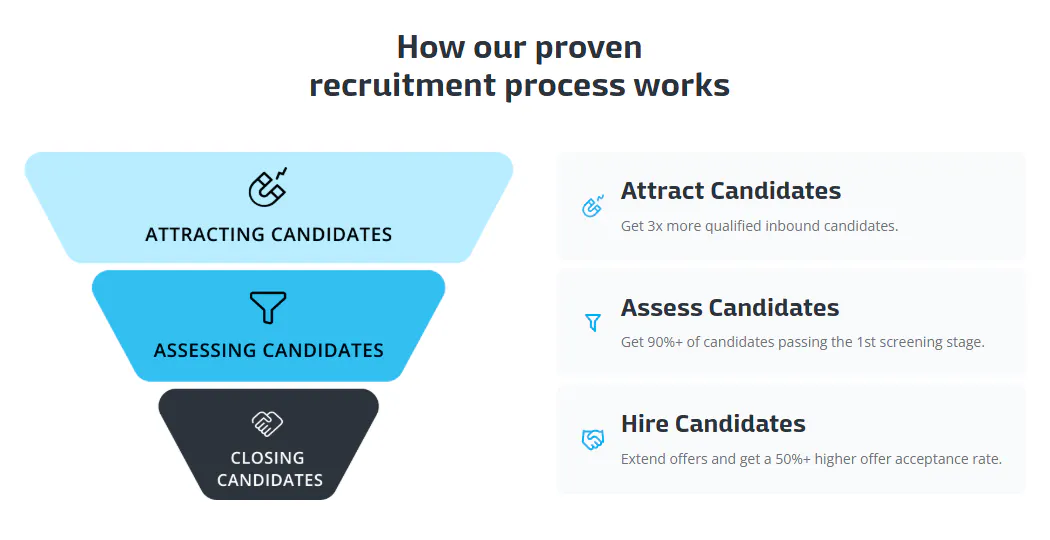
Our screening process distinguishes Backend from Data Science from ML Engineering from first contact, testing framework-specific knowledge, and verifying Python 3.9+ proficiency.
Results speak: first candidates within 48 hours, 96% of our permanent hires since 2022 stayed beyond the 90-day guarantee, 90%+ first screening pass, and 40-60% of US rates for European and Latin American talent.
No payment until you hire your chosen candidate.
Book a free consultation to discuss your Python needs-Backend, Data Science, or ML Engineering-and get matched candidates in 48 hours.
FAQ
What is the difference between a Backend Python Developer, a Data Scientist, and an ML Engineer?
Backend Python developers build web applications and REST APIs using Django, Flask, or FastAPI. They write production code handling authentication, database design, and API endpoints serving real users. Data scientists analyze business data in Jupyter notebooks using pandas and SQL, creating visualizations and statistical models to generate insights. ML engineers train custom models with PyTorch or TensorFlow and deploy them to production with MLOps practices - monitoring, versioning, and A/B testing at scale.
How much does it cost to hire Python developers in 2026?
Senior Backend Python developers cost $50-70k in Eastern Europe and $130-180k in North America. Data scientists command a 10-20% premium across regions. ML engineers cost 20-40% more than backend developers everywhere. Remote hiring from Eastern Europe (Poland, Romania) or Latin America (Brazil, Argentina) offers 40-60% cost savings compared to US salaries while maintaining quality talent.
Should I hire a Django developer, Flask developer, or FastAPI developer for my backend needs?
Choose Django for full-featured web applications requiring admin panels, ORM, and batteries-included tooling. Pick Flask for lightweight microservices where you want more control and API-first architecture. Select FastAPI for modern async APIs needing automatic OpenAPI documentation and type safety. Base your decision on project complexity and team familiarity with each framework.
Is Python 2 experience still relevant when hiring Python developers in 2026?
No. Python 2 reached end-of-life in January 2020 with no security updates since. Candidates listing only Python 2 experience signal outdated practices. Modern Python 3.9+ includes critical features like type hints, async/await, f-strings, and pattern matching that Python 2 developers may not know. Require Python 3 expertise.
What is the best country to hire remote Python developers from in 2026?
Eastern Europe (Poland, Romania) offers strong Backend Django and FastAPI talent at 40-60% of US costs. Brazil and Argentina provide excellent Python communities across all specializations with a US time zone overlap. Portugal combines EU timezone with below-average European salaries and a growing Python ecosystem. Choose based on the required time zone overlap and your specialization needs.
Tech hiring insights in your inbox
From engineers to engineers: helping founders and engineering leaders hire technical talent.
We will only ever send you relevant content. Unsubscribe anytime.