
I have some thoughts on hiring freelance vs. full-time remote developers from my experience working with startups to scale their teams.
I’ve seen technical hiring fracture into two distinct paths.
On one side, you have the flexibility of freelance developers who can move between projects with speed and autonomy.
On the other, there is the consistency of full-time remote developers, embedded within teams and aligned with long-term goals.
I’ve found that both models attract different kinds of talent and produce entirely different rhythms inside organizations.
At Remote Crew, we are focused as a team on helping companies make confident hiring decisions across multiple time zones, budgets, and product cycles.
We know there is often a lot of debate around whether to hire freelancers or full-time remote developers.
I will break down exactly where we stand on this topic and how you should think about this.
What Defines A Freelance Developer Relationship?
Freelancers operate as independent contributors who engage on defined scopes and timelines.
I’ve always felt their value lies in velocity and adaptability.
They fit into teams that need immediate production lift or specialized skills unavailable internally.
Payment structures favor outcomes over hours, which give teams precise control over cost exposure.
We often see companies deploy freelance engineers to accelerate development sprints or bridge hiring gaps.
Their contracts move fast because onboarding friction is minimal.
Freelancers adapt to shifting requirements and integrate into existing systems without needing cultural immersion.
Their incentive structure revolves around output and completion.
Here’s a table I’ve made on the typical traits of freelancers:
Attribute | Typical Trait | Operational Impact |
Engagement Length | Short-term or project-based | High flexibility, limited continuity |
Cost Structure | Hourly or per-project | Predictable budget control |
Availability | Variable | Requires clear scheduling |
Autonomy | High | Reduces management overhead |
Company Culture Alignment | Limited | Focused purely on deliverables |
What we've seen among fast-scaling startups is that freelance hiring injects speed into product delivery.
This makes them an essential piece of the hiring puzzle.
The ability to bring on expertise without extended negotiation cycles allows teams to meet deadlines that full-time models cannot match.
This agility creates momentum in early product development and testing phases.
Are Full-Time Remote Developers Needed For Long-Term Growth?
Full-time remote developers commit to deeper integration within teams.
Their alignment will extend beyond task execution into process improvement and system ownership.
Companies benefit in three ways:
- Consistency
- Knowledge retention
- Stronger cultural coherence
Remote employees embedded in strategy discussions tend to identify inefficiencies faster than external contractors.
We guide our clients toward full-time hiring when the project roadmap extends into multi-quarter or multi-year time horizons.
These roles favor complex infrastructure, shared accountability, and mentorship within distributed teams.
We’ve found that stability becomes an advantage when products evolve continuously rather than cycle through isolated sprints.
Here are some of the typical traits I see in full-time remote developers:
Attribute | Typical Trait | Operational Impact |
Engagement Length | Continuous | Strengthens institutional knowledge |
Cost Structure | Fixed salary | Stable financial planning |
Availability | Consistent | Allows for structured workflows |
Autonomy | Moderate | Balanced with collaboration needs |
Alignment with Company Culture | Strong | Reinforces team cohesion |
Full-time developers integrate decision-making habits into product teams faster than freelancers.
That’s just a fact.
Their visibility in communication channels and recurring meetings gives them greater influence over architecture and planning.
The compound effect is cultural stability that increases with every sprint cycle.
When Does Each Model Deliver The Highest Return?
The return-on-investment really depends on project scope, urgency, and internal team maturity.
Freelancers outperform in situations demanding immediate action.
We find their independence allows for rapid mobilization when sudden opportunities appear.
They plug into active workflows without disrupting internal hierarchies.
Whereas full-time developers outperform when complexity rises.
Large systems, long feedback loops, and intricate coordination require stable contributors who understand historical context.
Their deeper exposure to product vision reduces onboarding cycles for new initiatives.
This value accumulates across time and the reliability offsets the higher upfront cost.
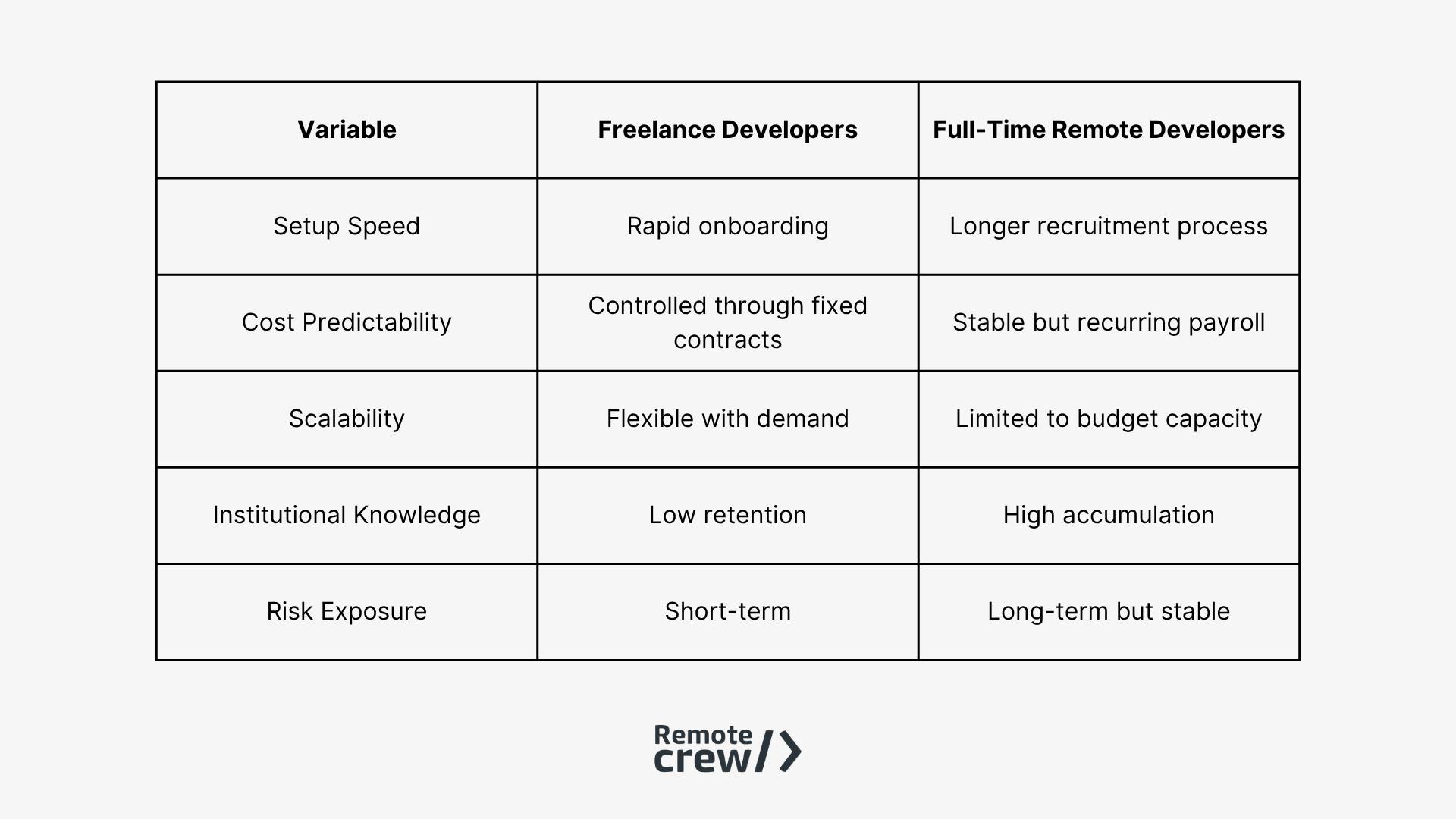
Generally speaking, hybrid strategies often yield an optimal balance.
Early-stage startups deploy freelance developers to reach milestones quickly, then transition successful collaborators into permanent roles as funding stabilizes.
The sequence creates continuity while retaining initial momentum.
Managing Team Culture & Communication Under Both Models
Cultural cohesion presents the hidden variable in all remote hiring.
Freelancers rarely attend long-term planning meetings.
They live at the perfect intersection of efficiency and detachment.
What does this mean for leaders? They must build clarity into task communication because verbal assumptions evaporate across short contracts.
We always recommend transparent documentation and asynchronous communication for mixed teams of freelancers and full-time developers.
Every project milestone includes:
- Scope validation
- Progress tracking
- Context summaries
All of these rituals help to maintain alignment between freelancers and full-time developers, even across fluctuating engagement models.
What we've seen in distributed engineering teams is that collaboration software becomes a cultural equalizer.
Communication hierarchies can be structured on Slack, Notion, and GitHub, which gives freelancers and employees shared visibility.
The absence of physical office cues makes written transparency the dominant trust signal.
Cultural design must extend into recognition systems.
Freelancers working alongside full-time employees need acknowledgment proportional to impact.
When recognition vanishes, engagement fades faster than output.
Teams that communicate appreciation explicitly retain top freelance talent for repeat collaborations.
We track productivity differences between teams with and without structured feedback.
The gap widens as projects scale.
You need to treat freelancers as short-term partners rather than external labor.
Here’s How Hiring Patterns Predict Success For Each Model
Freelance-heavy teams thrive when product roadmaps evolve quickly and market testing drives direction.
They absorb rapid pivots without internal disruption.
Full-time-heavy teams perform well when products reach architectural maturity and need continuous iteration. These patterns repeat across industries regardless of company size.
We often advise clients to pair one full-time technical anchor with a rotating circle of freelance specialists.
The anchor retains knowledge while freelancers deliver targeted expertise.
This composition creates a ton of elasticity.
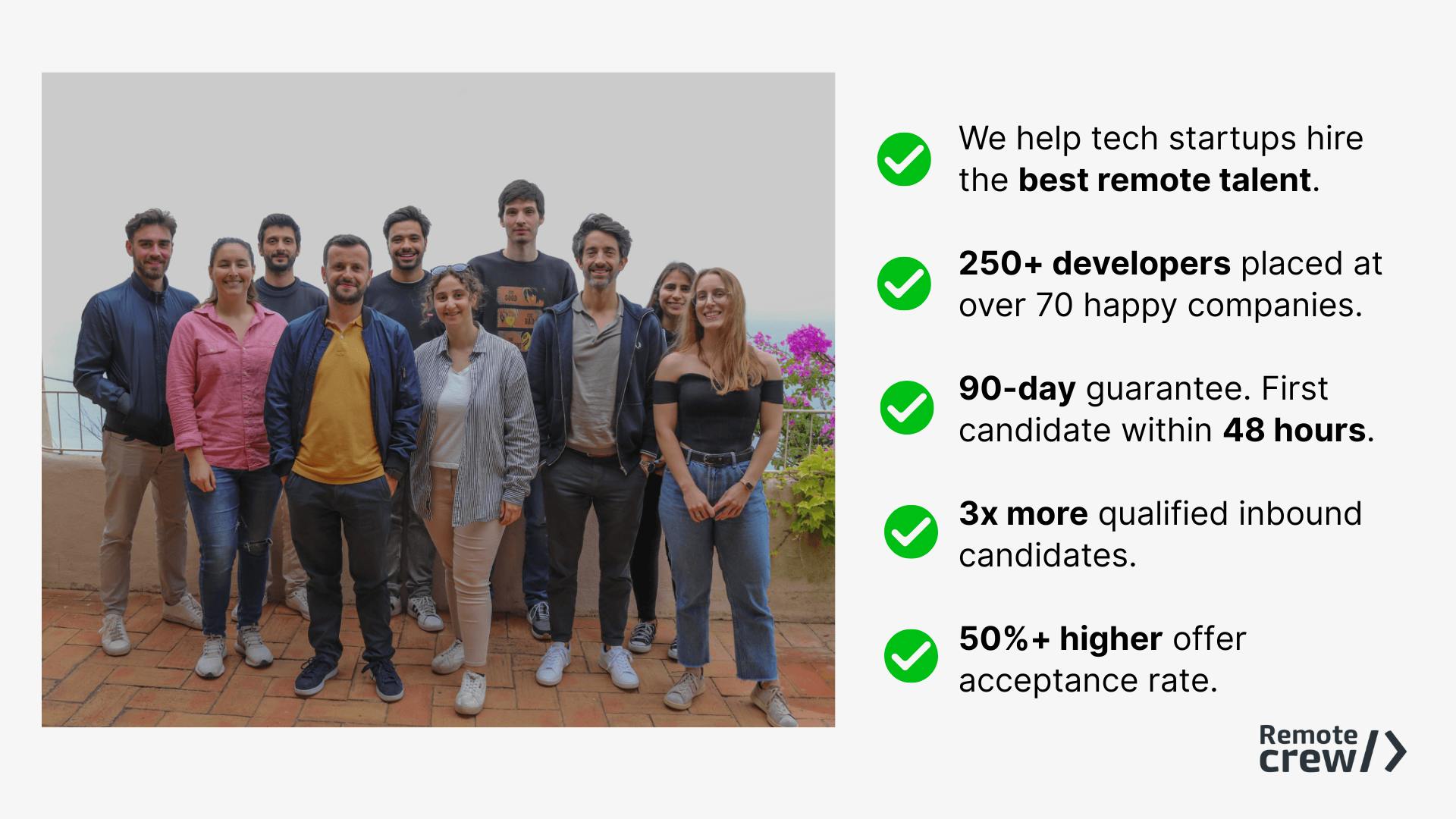
Remote Crew’s hiring frameworks rely on data captured from hundreds of placements across startups.
For us, this all comes down to one thing:
The art lies in selecting the right rhythm for the right stage of growth.
That’s our philosophy here.
Recruitment strategy reflects operational tempo.
You’ll find that freelancers amplify speed while full-time developers deepen the foundation.
Every placement, feedback loop, and dataset feeds into a sharper understanding of how distributed teams perform at scale.
So, rather than trying to choose between freelance and full-time talent, reframe the problem and focus on creating ecosystems where both models strengthen each other.
Not sure where to begin? That’s where we come in. Our team helps startups hire the best technical talent. You can start hiring with Remote Crew today.
Tech hiring insights in your inbox
From engineers to engineers: helping founders and engineering leaders hire technical talent.
We will only ever send you relevant content. Unsubscribe anytime.