

What if the candidates you are losing could tell you exactly how to hire them next time?
At Remote Crew, we spend every day inside remote tech recruitment for growing startups.
We see patterns most companies never get visibility on, including where…
- The hiring process stalls
- Strong developers disengage
- Teams slow themselves down
We also notice what happens when companies start listening systematically to candidates instead of guessing. That is where candidate feedback surveys become one of the most underestimated levers in remote developer hiring.
I’ll go a step further…
In 2026, a high-quality candidate feedback survey is the only way to win at hiring.
If you worry about the time it takes to hire remote developers and want to work out how to speed up the process, candidate feedback surveys will give you solid signals to act upon.
I’m going to tell you exactly how candidate feedback surveys improve outcomes across the remote developer hiring timeline.
Everything you are about to read is based on what we see daily at Remote Crew, supported by real benchmarks across tech hiring, and grounded in what actually moves the needle when you are competing for remote engineering talent.
If you feel a sense of relief once you have scrolled through this article, knowing that there is finally a way to shorten timelines and regain control over your hiring decisions, take that as your sign to move forward with us. We will present your first qualified remote developer candidate within 48 hours. Deal?
What Are Remote Developer Hiring Timelines Like Today?
Before talking about feedback, it is important to anchor expectations. Across industries, the global median time to hire sits around 38 days.
When you narrow that down to engineering roles, the numbers stretch. Median time to hire in engineering roles reaches roughly 41 days, with the slowest 10% of companies taking more than 80 days to close a hire. For software roles specifically, most benchmarks cluster between 40 and 50 days.
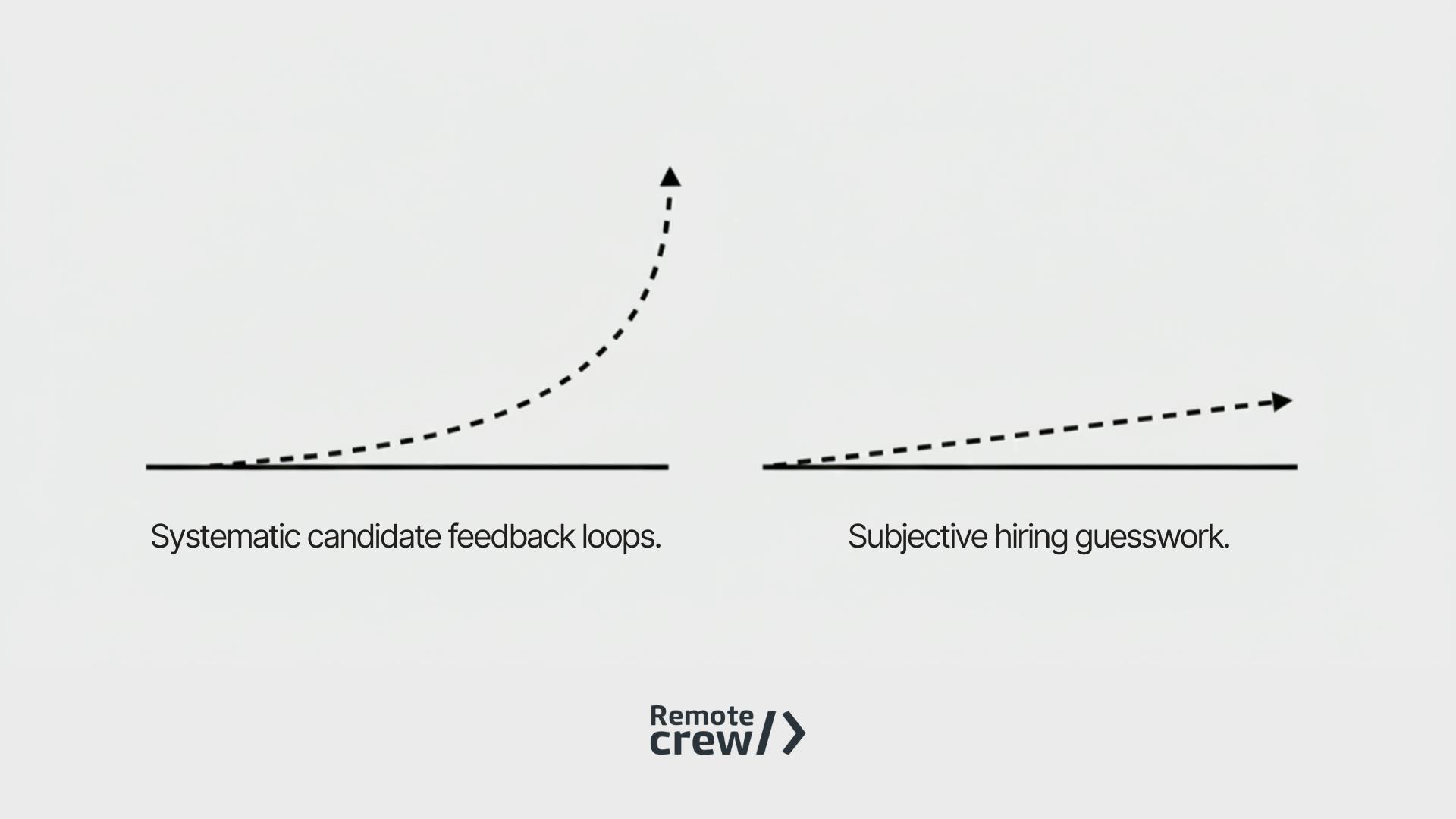
That means when founders ask how long it takes to hire a remote developer, the honest answer is that the time it takes to hire remote developers is already longer than most teams expect.
Remote hiring adds more…
- Variables
- Stakeholders
- Opportunities for friction
Hiring teams today are running significantly more interviews per hire than they did just a few years ago.
Interview volume has increased in recent years, which has pushed the average hiring time from the low 30s to over 40 days.
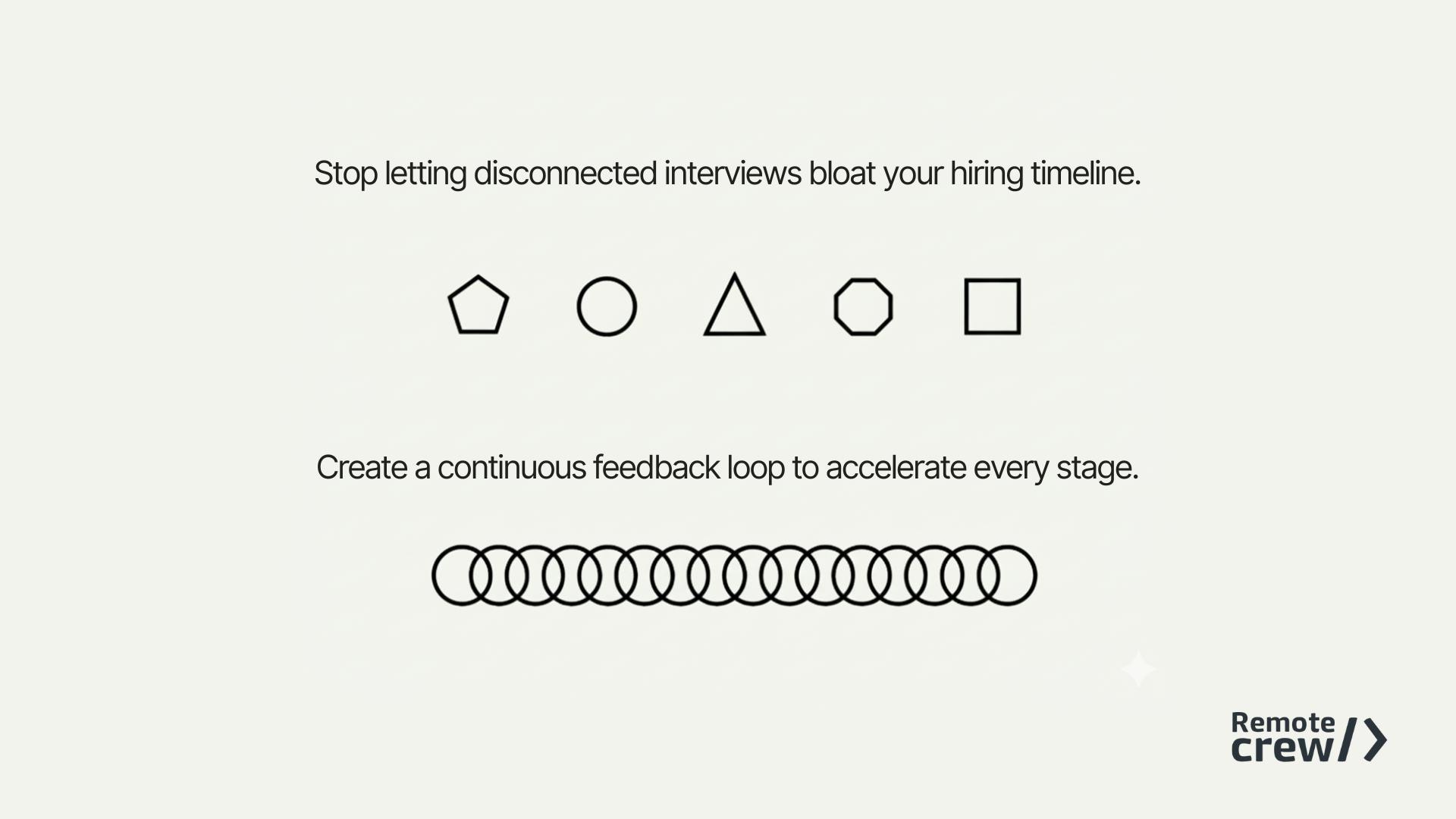
More interviews do not automatically mean better decisions. We’ve found that they mean slower decisions and worse candidate experience.
Remote Crew is focused on quality over quantity.
The last thing we want to do is present dozens of candidates that only loosely match your requirements.
We would rather share 3-4 perfect matches with you.
That way, you’re not wasting time reading through a full stack of applications.
It’s about keeping things moving.
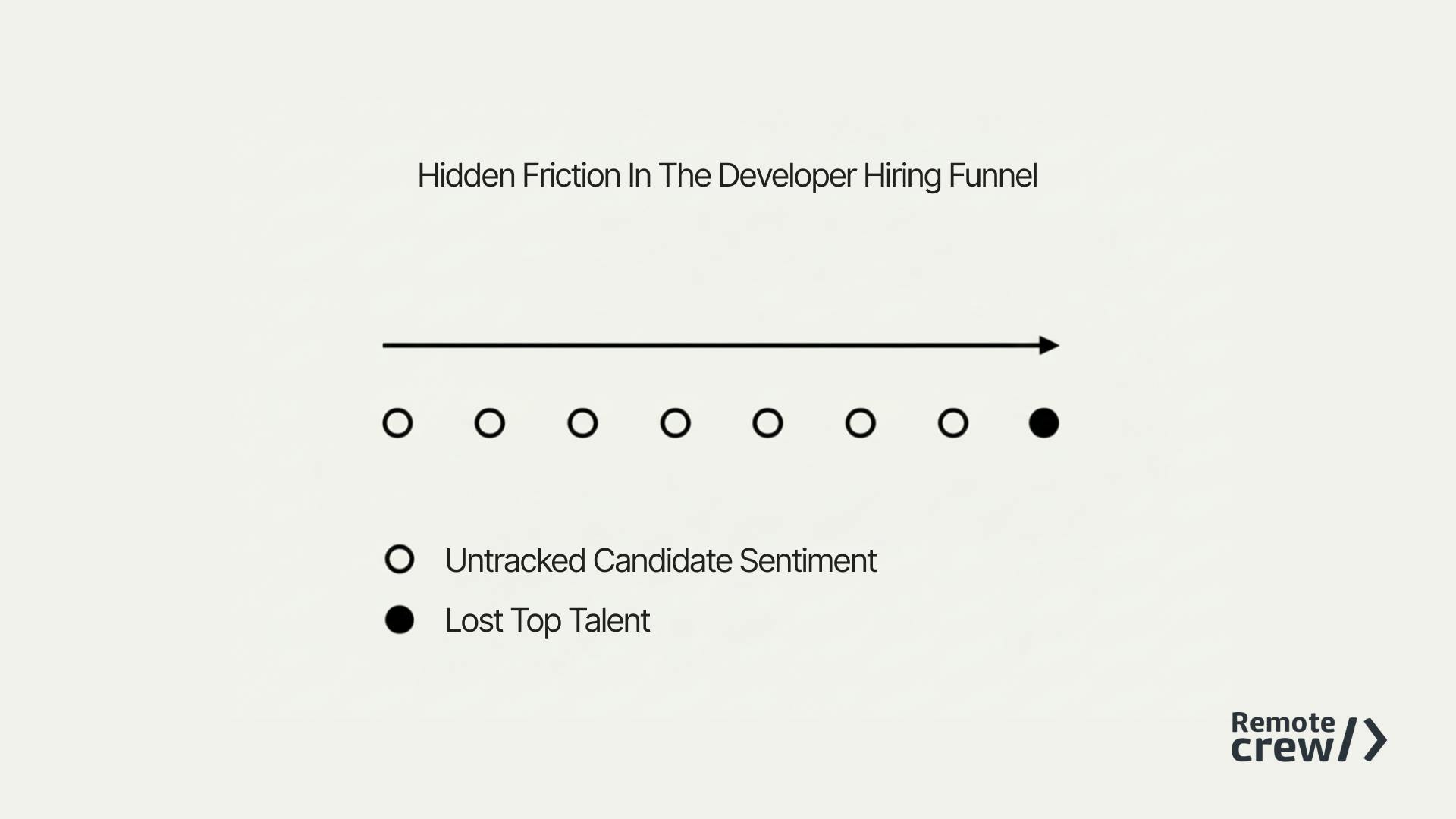
And that’s why candidate feedback surveys matter. These surveys expose exactly where the process feels bloated or unnecessary from the developer’s perspective.
Candidate Experience Directly Affects Hiring Speed
Here’s what I want you to remember about remote developers…
These professionals are evaluating you just as much as you are evaluating them.
Don’t think of them as passive applicants.
You need to think carefully about every touchpoint.
The likelihood that candidates disengage or accept another offer will increase with:
- Extra interviews
- Vague emails
- Delayed responses increase
Candidate feedback surveys will tell you a lot about how candidates perceive your hiring process.
For these surveys to work, make sure you do three things:
- Figure out what you don’t know.
- Keep the questions brief so it’s fast to complete.
- Collect quantitative and qualitative data.
Just as importantly, I want you to avoid these common mistakes when writing candidate feedback surveys:
- Asking leading or defensive questions that push candidates toward a “safe” answer.
- Making the survey too long or repetitive, which lowers completion rates.
- Using vague questions that don’t point to a specific stage or interaction.
- Sending the survey too late, when feedback becomes blurred or emotional rather than accurate.
- Failing to close the loop by acknowledging feedback or acting on obvious issues.
At Remote Crew, my team and I regularly see companies surprised by feedback that mentions issues like unclear role expectations, repetitive interviews, or poorly framed technical assessments.
These issues directly affect time to hire in remote tech roles because they increase drop-off rates late in the funnel.
When candidates feel respected and informed, they move faster. If candidates feel uncertain or are tested unnecessarily, they slow down or exit.
What Are The Blind Spots In Your Hiring Funnel?
I’ve found that most companies track stages and very few look at sentiment. That gap creates blind spots that extend the remote developer hiring timeline.
Let’s take a second to think about the basic hiring timeline most teams operate with:
- Sourcing takes one to two weeks, depending on geography.
- Screening and interviews take two to three weeks, often longer when interviews pile up.
- Technical assessments add another week.
- Offer and negotiation can take one to two weeks.
- Notice periods, especially in Europe, can add one to two months.
Yes, on paper, this timeline looks reasonable. However, in reality, candidate feedback often reveals unnecessary delays between steps and slow decision-making that add invisible days or weeks.
We find candidate feedback surveys useful because they pinpoint where things start to break.
The surveys reveal which stages are confusing or misaligned. That insight allows hiring teams to compress timelines without lowering standards.
You Can Use Candidate Feedback Surveys As A Diagnostic Tool
We like to think of candidate feedback surveys as diagnostic tools.
When designed correctly, it answers questions like:
- Did you understand the role and expectations clearly?
- Was the interview process efficient, or did it feel excessive?
- Was communication timely and transparent?
- Did the technical assessment feel relevant to the job?
- Did you feel respected throughout the process?
These answers directly correlate with benchmarks for hiring remote developers. Companies that score poorly on clarity and communication almost always sit at the higher end of time to hire remote developers.
At Remote Crew, we integrate feedback loops directly into the hiring funnel. This allows us to adjust sourcing, screening, and interview flow quickly rather than waiting until roles fail.
Feedback Shortens The Screening & Interview Phase
From what we’ve seen, the screening and interview phase is where most hiring time is lost.
Data shows that increased interview volume is a major driver of longer hiring cycles.
Candidate feedback surveys often reveal that later-stage interviews feel repetitive or misaligned.
We’ve heard from developers that they find themselves answering the same questions multiple times for different team members.
Equipped with this feedback, hiring teams can take targeted action to improve the interview process.
This directly impacts how long it takes to hire a remote developer because interview efficiency is the largest controllable variable in the process.
How Can Feedback Improve Technical Assessments?
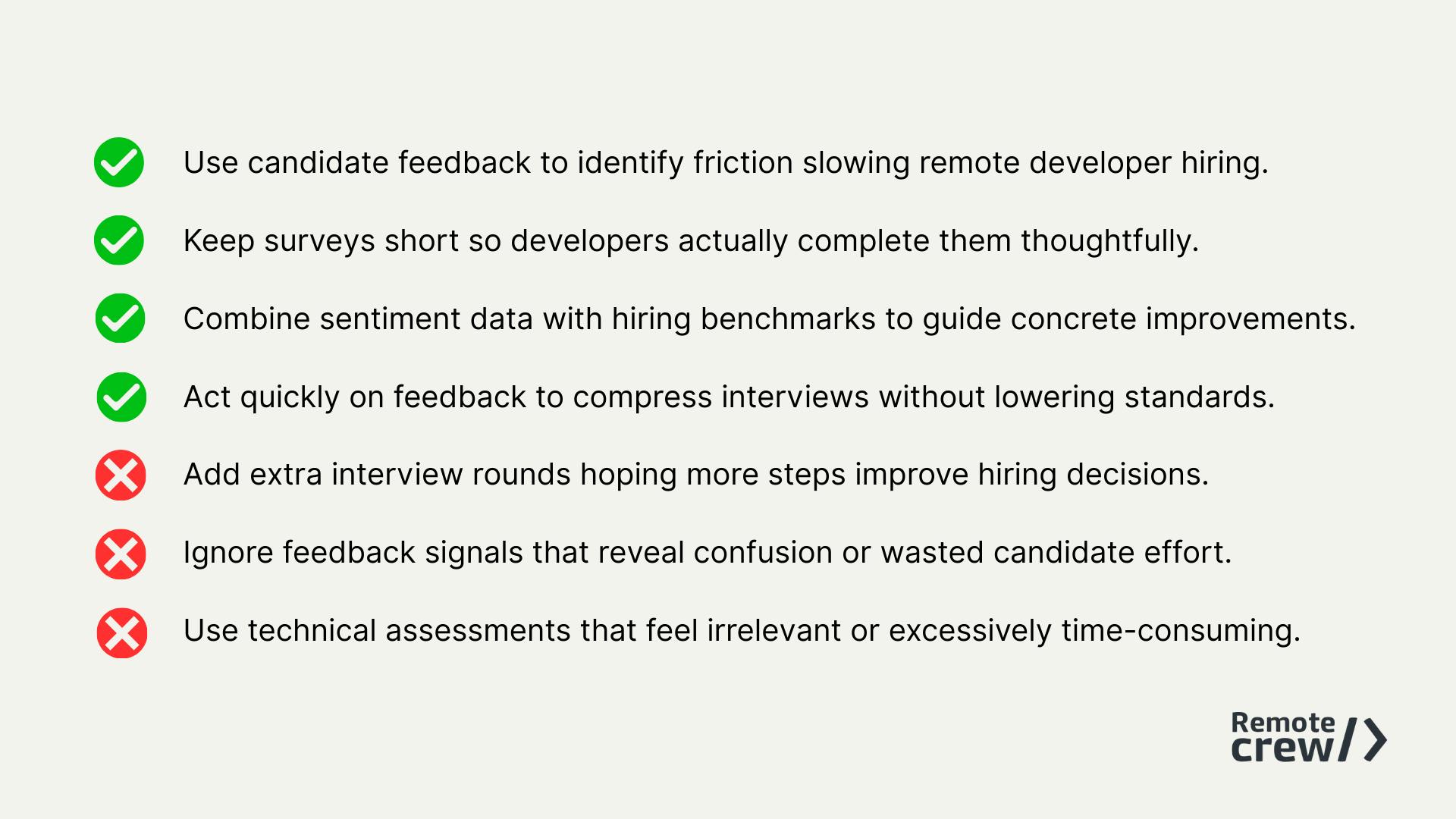
We see technical assessments as another major friction point. Developers are increasingly selective about how they spend their time. Long or irrelevant assignments create drop-off.
Data from candidate feedback surveys will tell you which assessments offer genuine value versus those that seem completely redundant.
At Remote Crew, feedback has helped us calibrate assessments to be…
- Job-relevant
- Time-bound
- Respectful
We’ve found that this improves completion rates and reduces the time it takes to hire remote developers.
Ultimately, we’re on a mission to keep strong candidates engaged.
Any information we can use to bring us closer to that goal is a win.
Feedback surveys will explain why candidates hesitate or decline offers.
Here are some common themes we’ve seen:
- Unclear compensation discussions
- Delayed feedback after final interviews
- Sudden changes in role scope
These issues directly extend the remote developer hiring timeline.
When companies use feedback proactively, they can address concerns earlier and increase acceptance rates. That shortens the overall time to hire in remote tech roles.
5 Great Examples Of Feedback-Driven Hiring Improvement
Here is a useful table on how candidate feedback can influence each stage of the hiring process:
Hiring Stage | Common Issue Without Feedback | Insight From Candidate Feedback | Timeline Impact |
Sourcing | Low response rates | Job description unclear or misaligned | Faster inbound alignment |
Screening | High early drop-off | Confusing expectations or slow replies | Reduced early exits |
Interviews | Too many rounds | Repetitive or unfocused interviews | Shorter interview cycles |
Assessments | Low completion | Irrelevant or time-heavy tasks | Higher completion rates |
Offers | Declines or delays | Uncertainty on compensation or role | Higher acceptance speed |
As you can see, feedback has the potential to translate directly into a shorter hiring process.
When we’re working with companies to hire the best remote talent, we’re always looking for ways to give them a competitive edge.
At every hiring stage, there are opportunities to tighten up processes and deliver improved candidate experiences.
Sometimes, these opportunities are not obvious.
This is why companies value having our team’s input.
We look at your hiring processes through an objective lens to identify specific opportunities for optimization and increased efficiency.
Can You Afford Not To Use Candidate Feedback Surveys?
Of course, you can’t!
What if your remote developer hiring process consistently delivered strong candidates quickly, without drop-offs or last-minute surprises?
Teams that implement structured candidate feedback surveys see…
- Faster decisions
- Higher acceptance rates
- Shorter time-to-hire
Once feedback is built into the funnel, bottlenecks become visible immediately and timelines begin to compress within the same hiring cycle.
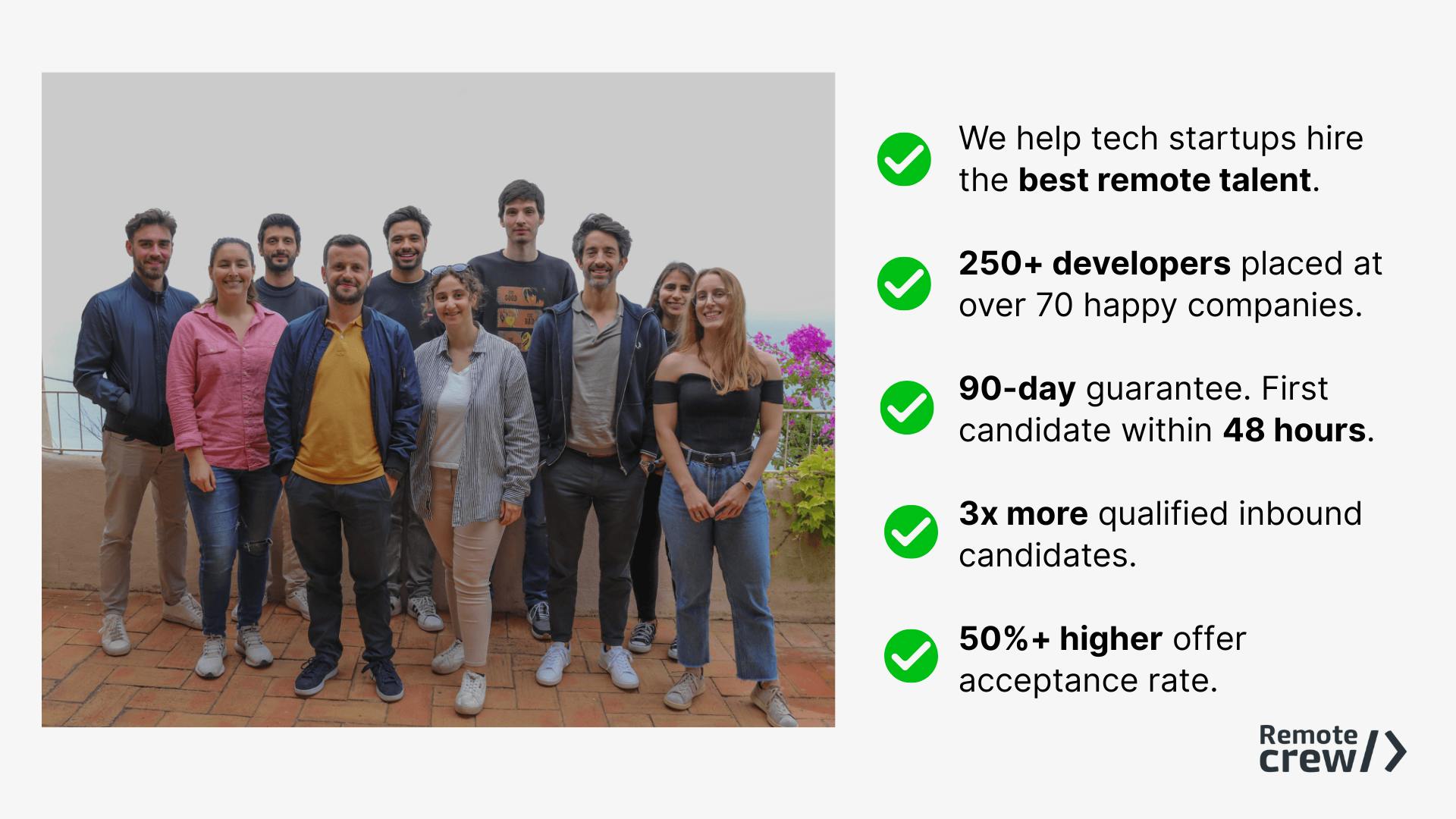
If you want to shorten your remote developer hiring timeline and see qualified candidates within 48 hours, start hiring with Remote Crew today.
Tech hiring insights in your inbox
From engineers to engineers: helping founders and engineering leaders hire technical talent.
We will only ever send you relevant content. Unsubscribe anytime.