

React Native powers mobile apps at Meta, Shopify, and Discord, but most companies struggle to find developers who can actually build production cross-platform applications.
The problem is that "React Native developer" on a resume often means someone who built a weekend Expo project, not someone who can write Swift bridges, optimize JavaScript-to-native communication, or ship apps through App Store review.
Companies interview dozens of React web developers claiming mobile expertise, only to discover they've never touched native code, don't understand platform-specific constraints, or freeze when asked about offline-first architecture.
At Remote Crew, we've hired 150+ remote developers and interviewed 1,500+ candidates across every role. We've seen exactly where React Native hiring breaks down.
This guide provides a systematic approach covering the preparation and hiring phases, along with frameworks to distinguish genuine React Native proficiency from surface-level experience.
TL;DR: Main Takeaways
- React web developers are not automatically qualified for React Native mobile development.
- Expo (managed workflow, easier setup, limited native access) and Bare React Native (full native control, requires Swift/Kotlin) attract completely different developer profiles.
- Native module experience commands a 15-20% salary premium. Developers who can write custom Swift/Kotlin bridges earn significantly more than Expo-only developers because they solve problems the managed workflow can't handle.
- React Native developers earn an average of $95-140K annually in the United States, while remote React Native developers with native module experience earn $50-78K in Eastern Europe and $42-70K in Latin America - a 40-60% cost reduction without sacrificing quality.
- Outreach delivers first qualified candidates in 48 hours. Job boards take weeks and attract only React web developers claiming mobile expertise without having shipped real apps.
- Remote hiring wins for 80%+ of React Native projects. On-site only makes sense for highly regulated industries requiring physical presence.
Criteria | Remote | On-Site |
Talent Pool Size | Global (thousands) | Local (dozens) |
Cost Range (Senior) | $50-70k | $120-150k |
Time to Hire | 1-2 weeks | 4-6 weeks |
Native Module Expertise | High availability | Limited locally |
Infrastructure Costs | $0 (remote setup) | $3-7k per seat |
When to Choose | Most mobile projects | Regulated industries only |
When Do You Need React Native Developers
- Building iOS and Android apps from a single codebase without maintaining separate native teams
- Product roadmap that requires mobile apps sharing code with existing React web properties
- Faster development cycles needed more than native iOS/Android allows - cross-platform reuse accelerates shipping
- App requires native device features (camera, GPS, sensors, offline storage) beyond what PWAs offer
- Scaling a mobile product with developers working across both platforms without duplicating effort
- Existing React Native app needs maintenance, feature additions, or version upgrades
- Evaluating frameworks and need expertise to assess React Native vs Flutter vs native development
Three Stages of Hiring React Native Developers
Successful React Native hiring requires three structured phases:
- Phase 1 (Before Hiring) - Define your 1-page recruitment plan covering Expo vs Bare workflow, native module needs, platform requirements (iOS/Android/both), React Native version, and state management approach. This alignment prevents hiring the wrong expertise.
- Phase 2 (During Hiring) - Source actual React Native developers (not just React), conduct mobile-specific technical interviews, and administer practical tests under 2 hours, assessing real-world mobile expertise.
- Phase 3 (After Hiring) - Onboard with React Native documentation, mobile environment setup, physical test devices, and 60-day milestones.
This guide focuses on Parts 1 and 2 only - the preparation and active hiring phases.
Part 1: What You Need to Do Before Hiring React Native Developers
Most hiring managers jump straight to posting jobs without defining what they actually need. That's why they waste weeks interviewing Expo-only developers for roles requiring custom native modules, or rejecting strong candidates because stakeholders never aligned on requirements.
This phase determines 80% of your hiring success before you write a single job post.
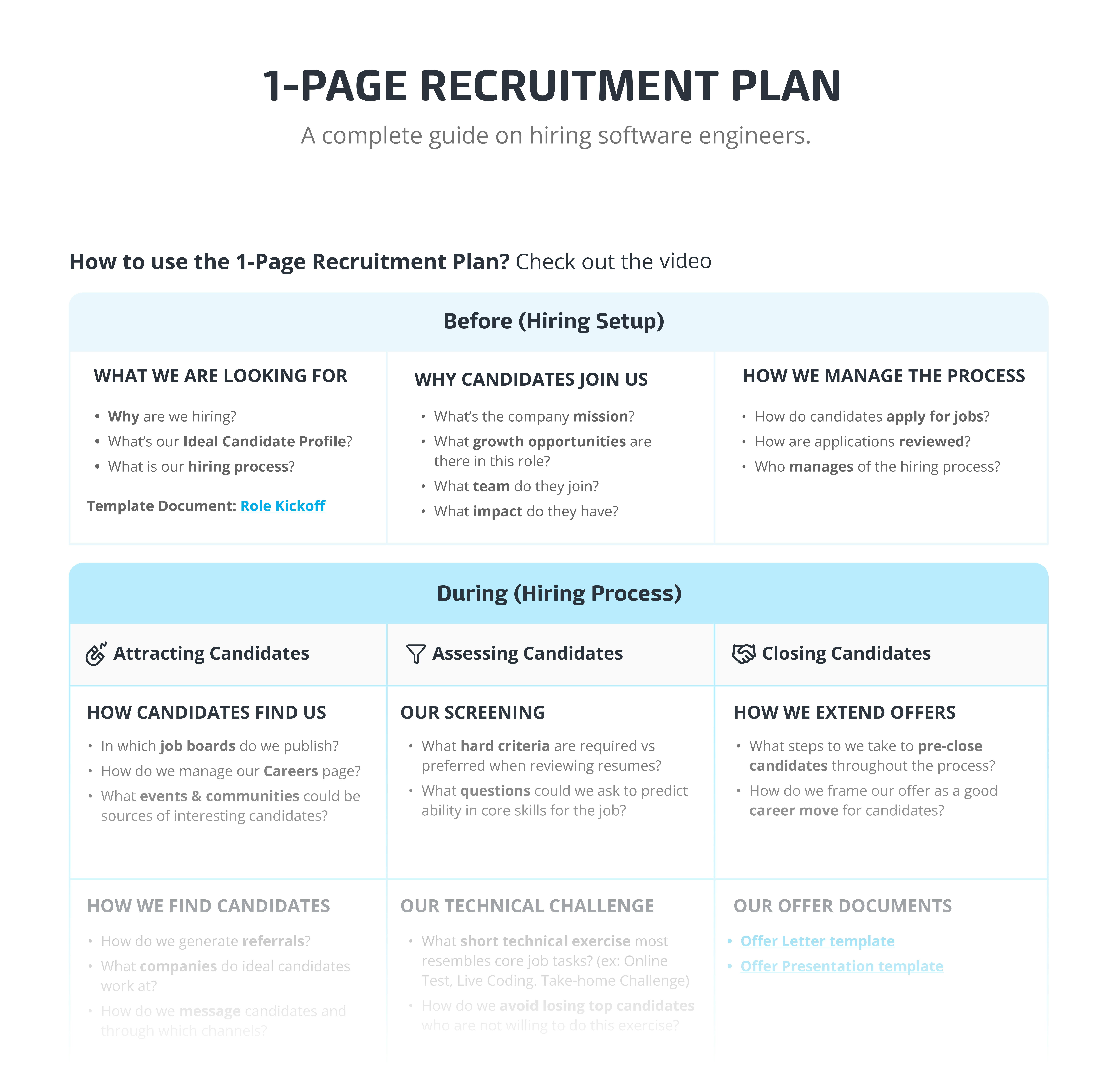
Create Your 1-Page Recruitment Plan for React Native Developers
Without a written role definition, everyone operates on different assumptions. Your CTO wants someone who can write Swift bridges for custom camera functionality. Your tech lead writes a job description for Expo managed workflow experience. You end up rejecting candidates who'd satisfy one stakeholder but frustrate the other.
A 1-page recruitment plan prevents this disaster. It forces alignment before you waste time interviewing candidates nobody will hire.
- Business Problem: Specify the exact mobile challenge this hire solves. Not "improve our app" - be concrete: "Migrate from Expo managed to Bare React Native to integrate a custom camera module for document scanning" or "Build offline-first functionality for the field sales team accessing customer data without connectivity."
- Technical Requirements: Differentiate must-haves from nice-to-haves. Must-haves: React Native version (0.71+ for New Architecture features or 0.6x if maintaining legacy), Expo vs Bare workflow, native module needs, platform scope (iOS/Android/both). Nice-to-haves: New Architecture experience, Hermes optimization, CodePush deployment.
- What's in it for them: Highlight technical challenges they'll own, who they'll work with, learning opportunities, and a growth path in mobile specialization. If you can't answer this convincingly, you'll struggle to close strong candidates.
Have the founder, hiring manager, and technical interviewers review and sign off on this document before posting the role.
Download our free 1-Page Recruiting Plan template to get started faster.
Expo vs Bare React Native: Which Expertise Do You Need?
This decision fundamentally changes who you hire. Expo and Bare developers have different skill profiles - an Expo-only developer will struggle with native module integration.
- Expo (Managed Workflow): Easier setup, faster development, but limited to Expo SDK capabilities. Hire for: MVPs, startups validating product-market fit, apps with standard features like auth, camera, and push notifications.
- Bare React Native: Full native control, custom modules in Swift/Kotlin, can integrate any native library. Hire for: Apps needing custom native functionality, performance-critical applications, integration with existing native codebases.
Many experienced developers know both, so ask specifically about workflow experience and native module work during interviews. Specify workflow type in your job posting so candidates self-select appropriately.
Understanding React Native Seniority Levels (And How They Fit Your Requirements)
- Junior (1-3 years): Expo basics, component building, React Navigation, simple API integration, Context API or basic Redux, simulator testing.
- Mid (3-5 years): Bare React Native, state management at scale (Redux Toolkit, Zustand), performance optimization, platform-specific code, real device testing, app store deployment experience.
- Senior (5+ years): Custom native modules (Swift/Kotlin), cross-platform architecture decisions, bridge optimization, version upgrade strategies, mentoring capabilities.
Warning: React Native evolves rapidly. A motivated 3-year developer with 4 shipped apps using modern patterns outperforms a 7-year developer stuck on outdated approaches. Focus on what they've built, not resume tenure.
Salary Expectations for React Native Developers
React Native commands premium rates due to the scarcity of mobile specialists, dual-platform expertise (iOS + Android), and knowledge of native modules. Rates sit slightly above Angular but below native iOS/Android specialists.
Developers who can write custom Swift/Kotlin bridges command 15-20% more than Expo-only developers. This combination of skills is rare.
Cost arbitrage opportunity: Eastern Europe and Latin America offer comparable React Native talent at 40-60% of US rates, with strong time zone overlap. Remote is the better option than on-site.
Region | Junior (Annual) | Mid-Level (Annual) | Senior (Annual) | Hourly Rate (Contract) |
North America | $65,000-$85,000 | $95,000-$135,000 | $135,000-$185,000 | $105-$160 |
Western Europe | $48,000-$68,000 | $75,000-$105,000 | $105,000-$145,000 | $85-$125 |
Eastern Europe | $32,000-$48,000 | $48,000-$75,000 | $70,000-$100,000 | $55-$85 |
Latin America | $28,000-$42,000 | $42,000-$65,000 | $60,000-$90,000 | $45-$75 |
How to Write a Compelling Job Description for React Native Developers
Open with the specific mobile problem they'll solve, not company history. Example: "You'll rebuild our mobile checkout flow to handle offline transactions for 50K daily orders across iOS and Android."
- Critical mistake to avoid: Requiring "React Native AND Flutter AND Native iOS" together. These are different specializations, and you'll get zero qualified applicants. Choose your framework and hire for depth, not breadth.
- Specify workflow type explicitly: State "Expo managed workflow" or "Bare React Native with custom native modules" upfront so candidates self-select appropriately.
- Include React Native version: Mention if you're on the latest versions (0.71+ with New Architecture features) or maintaining a legacy app (0.6x requiring migration experience).
- State platform requirements: "iOS only," "Android only," or "Both platforms with platform-specific code experience" - developers often have stronger experience on one platform.
- Native module needs: Be explicit if the role requires writing custom Swift/Kotlin code vs using pre-built modules only.
- State management approach: Mention if you use Redux, Zustand, MobX, Recoil, or other libraries, so candidates know your stack.
- Testing expectations: Clarify if you require unit testing (Jest), component testing (React Native Testing Library), E2E testing (Detox/Appium), or manual device testing only.
- Include salary range: Critical for React Native roles because compensation varies significantly based on Expo vs Bare expertise and native module skills.
- React Native Job Description Must-Haves: (1) Workflow type (Expo vs Bare), (2) React Native version, (3) Platform requirement (iOS/Android/both), (4) Native module needs (yes/no + languages if yes), (5) State management library, (6) Testing approach, (7) App store deployment requirement, (8) Salary range.
Part 2: During Hiring - How to Identify the Best React Native Developers
Most companies post jobs and wait for applications. That's the wrong approach. The best React Native developers aren't browsing job boards - they're already employed and responding to recruiter outreach. This phase requires active sourcing, mobile-specific technical questions, and tests that mirror real cross-platform work.
How to Source React Native Developers on LinkedIn
Use "React Native" in your search filters - NOT just "React." These are completely different skillsets. A React web developer isn't automatically qualified for mobile development.
Add specific workflow keywords: "Expo" OR "Bare" OR "native modules" to filter for the expertise you need. This separates developers who've worked with different React Native architectures.
Target companies known for React Native production work: Meta, Shopify, Discord, Wix, Coinbase, Bloomberg. Developers from these companies have scaled mobile apps to millions of users.
Check GitHub repositories for React Native contributions, published npm packages, and personal projects with App Store or Play Store links. Public code reveals more than resumes.
Here's an outreach message that works:
"Hi [Name] - saw your work on [specific React Native project]. We're building [product] using [Expo/Bare workflow] and need someone who can [specific native module requirement]. Role is $[range] + equity, fully remote. We need help with [specific technical challenge]. Worth a quick chat?"
This works because it's specific about workflow, mentions compensation upfront, and shows you actually reviewed their work.
What Questions to Ask During the Interview for a React Native Developer Role
Ask these React Native-specific questions to separate mobile developers from web developers who claim React Native experience:
- Expo vs Bare: "Explain the difference between Expo managed and Bare workflows - when would you choose each?" - Tests understanding of React Native's fundamental architecture split.
- Native modules: "Have you written custom native modules? Walk me through bridging JavaScript to Swift/Kotlin" - Separates developers who can extend React Native from those limited to existing modules.
- Performance: "How do you optimize React Native performance around the bridge and rendering?" - Tests mobile-specific performance knowledge.
- Platform-specific code: "How do you handle code that behaves differently on iOS vs Android?" - Assesses real cross-platform experience.
- State management: "How do you handle offline state and sync with backend in a large-scale mobile app?" - Tests mobile-specific state challenges.
- App store deployment: "Walk through your process for deploying to App Store and Google Play. What rejections have you faced?" - Reveals end-to-end mobile experience.
- Version upgrades: "Describe a React Native version upgrade you've managed" - Tests maintenance experience with the evolving framework.
- Offline-first: "How would you implement offline-first functionality for a data-heavy app?" - Mobile-specific architecture challenge web developers don't face.
Green Flags vs Red Flags for React Native Developers
Category | Green Flags | Red Flags |
React Native vs React Knowledge | Understands React Native-specific patterns (bridge, native modules, platform code) | Treats React Native as just React in a mobile wrapper |
Expo vs Bare Proficiency | Explains trade-offs, understands when each applies | Only knows one workflow, can't explain why or when to switch |
Native Module Experience | Has written custom native modules in Swift/Kotlin | Has never touched native code, assumes everything works in JavaScript |
Performance Optimization | Discusses bridge optimization, FlatList virtualization, memory management | Unaware of mobile performance constraints |
App Store Knowledge | Has shipped to both App Store and Play Store, understands review guidelines | Has never deployed to app stores |
Candidates showing 7+ green flags typically pass probation with a 95%+ success rate based on our placement data.
How to Do Technical Testing for React Native Developers
Keep tests under 2 hours with a starter template provided (Expo or Bare, matching your stack). Longer tests filter out candidates with options.
Sample project ideas mirroring real mobile work:
- Implement a product list with infinite scroll using FlatList, optimized for 1000+ items
- Add offline capability to a notes app using AsyncStorage with sync when the connection returns
- Implement platform-specific behavior (iOS action sheet vs Android bottom sheet)
Evaluate: component architecture, platform-specific handling (.ios.js/.android.js files), performance awareness (FlatList usage, avoiding re-renders), state management choices, TypeScript discipline, and error handling for mobile edge cases.
Live coding alternative: If concerned about AI assistance, conduct a 60-minute live coding session where you watch them work in real-time.
Modern developers use AI tools in their daily work. Focus on whether they can explain their choices and reasoning, not whether they used assistance.
React Native Developer Skills - Complete Checklist
Use this checklist during candidate evaluation to assess both technical capability and remote work readiness systematically.
Must-Have Technical Skills:
- React Native 0.71+ proficiency
- TypeScript
- React Navigation
- State management (Redux/Zustand/Context)
- REST/GraphQL API integration
- iOS and Android device testing
- App store deployment experience (TestFlight, Play Console)
- Debugging with Flipper
- Git version control
Nice-to-Have Technical Skills:
- Native module development (Swift/Kotlin)
- React Native New Architecture (Fabric, TurboModules)
- CodePush/OTA updates
- E2E testing (Detox)
- CI/CD for mobile (Fastlane, Bitrise)
- Advanced animations (Reanimated)
- Offline databases (SQLite, Realm)
Critical Soft Skills for Remote Work:
- Async communication clarity
- Self-direction without constant oversight
- Strong documentation habits
- Clear written technical communication
Developers showing 7+ must-haves plus 3+ nice-to-haves typically pass probation with 95%+ success rates based on our placement data.
Common Mistakes When Hiring React Native Developers
After interviewing 1,500+ developers, these mistakes consistently derail React Native hiring:
- Confusing React web developers with React Native developers. Completely different skillsets requiring native mobile knowledge. Specify "React Native" explicitly in job postings.
- Not specifying Expo vs Bare workflow. Fundamentally different skill profiles. Expo developers often lack native module experience. Bare React Native developers understand iOS/Android bridging. Specify which you need or attract misaligned candidates.
- Ignoring native module experience when your app requires custom device integrations like Bluetooth, camera features, or hardware access.
- Overlooking the app store deployment experience. Ask specifically about shipping to App Store and Play Store - TestFlight, provisioning profiles, and Play Console knowledge matters.
- Hiring developers who only test on simulators. Real device testing is non-negotiable. Simulators miss performance issues and platform-specific bugs.
- Falling into the experience trap. React Native launched in 2015. Focus on shipped apps, not resume tenure.
- Testing with generic React/web questions. Use mobile-specific scenarios: bridge optimization, platform-specific code, offline handling, and app lifecycle management.
React Native Developer Hiring Checklist
Before you start
- Create a 1-page recruitment plan with mobile-specific requirements.
- Decide Expo vs Bare workflow upfront.
- Define native module needs clearly.
- Set a realistic budget - account for a 15-20% premium if native modules are required.
- Write a job description with the 8 must-haves from the checklist above.
During sourcing - Search "React Native" specifically on LinkedIn, not just "React."
- Target companies known for React Native (Meta, Shopify, Discord, Wix).
- Check GitHub for mobile projects with app store links.
- Use a concentric circles approach, starting with narrow criteria.
During screening - Ask about Expo vs Bare experience and trade-offs.
- Probe native module development with specific examples.
- Assess platform-specific code handling.
- Verify app store deployment experience.
- Evaluate offline-first architecture understanding.
Technical testing - Keep under 2 hours.
- Provide a starter template matching your stack (Expo or Bare).
- Test real mobile scenarios - offline handling, performance optimization, platform-specific behavior.
- Conduct a review call to assess the depth of understanding.
Evaluation - Check for 7+ green flags from the comparison table.
- Verify real device testing on physical iOS and Android devices.
- Confirm they can explain technical trade-offs, not just implement features.
Should You Hire React Native Developers On-Site or Remote?
Remote hiring wins for 80%+ of React Native projects. The talent pool difference is dramatic - React Native specialists are scarce locally, but remote work expands your options to the global community.
Criteria | Remote Hiring | On-Site Hiring | Why It Matters |
Talent Pool Size | Global React Native community | Local mobile developers only | React Native specialists are scarce, remote expands options dramatically |
Time to Hire | 48 hours to the first candidates | 2-4 weeks | Faster shipping |
Cost Range Senior | Eastern Europe $50-78K, LatAm $42-70K | US $95-140K | 2x team at the same budget |
Expo + Bare Specialists | Global pool includes both workflow types | Limited by the local market | Easier to find an exact match remotely |
Infrastructure Costs | $0-minimal | $3-7K per seat | Overhead savings |
The numbers tell the story. You're paying half the salary for comparable talent while accessing developers who specialize in your exact workflow - whether that's Expo or Bare React Native with custom native modules.
On-site only makes sense for highly regulated industries requiring physical presence or classified work. For everyone else, remote hiring delivers better talent faster at lower cost without the infrastructure overhead.
Let the Experts Find the Best React Native Developers for You
Remote Crew specializes in finding, vetting, and placing React Native developers using the exact framework you just read. We've refined this process across 150+ placements with a 99% probation pass rate.
- Our React Native expertise goes deep. We distinguish Expo from Bare workflow specialists, assess native module development capability (Swift/Kotlin bridging), verify real device testing practices, confirm app store deployment experience (App Store and Google Play), and evaluate performance optimization knowledge specific to mobile cross-platform work.
- Pre-vetted developer network. We source high-performing React Native developers from Eastern Europe and Latin America with verified mobile app portfolios - developers who've shipped real apps you can download and test, not just tutorial projects.
- Fast placement. First React Native candidates delivered within 48 hours, typical placement completed in 4-6 weeks with mobile-specific technical screening.
- Risk-free model. You don't pay anything until we deliver the candidate you'll hire. We handle sourcing, technical vetting, interview coordination, and reference checks.
Book a free consultation to discuss your specific React Native needs - whether you need Expo expertise for rapid MVP development or Bare workflow specialists for custom native module integration. We'll show you our evaluation process with real candidate examples matching your requirements.
FAQ
What's the difference between React developers and React Native developers?
React developers build web applications using HTML/CSS rendered in browsers, while React Native developers build native mobile apps for iOS and Android using JavaScript that compiles to native components. They're completely different platforms with different constraints, APIs, and deployment processes. A React web developer doesn't automatically know React Native's mobile-specific components, native modules, bridge architecture, app store submission, or cross-platform mobile development patterns. Always hire for React Native experience specifically, not just React.
What should I expect to pay for React Native developers in 2026?
Salaries vary by region and expertise level. North America senior developers with native module experience cost $120-150k, Western Europe $100-130k, Eastern Europe $55-75k, Latin America $50-70k, Southeast Asia $45-65k. Developers who can write custom native modules command a 15-20% premium over Expo-only developers because they solve problems requiring Swift/Kotlin code that the managed workflow can't handle. Remote hiring from Eastern Europe or Latin America delivers comparable app quality at 40-60% cost savings versus US rates.
Should I hire for Expo or Bare React Native workflow expertise?
Choose Expo if you're building an MVP with standard features covered by Expo SDK - authentication, basic camera, push notifications, maps - and want faster development without native code complexity. Choose Bare React Native if you need custom native modules not in Expo, performance-critical apps requiring bridge optimization, integration with existing native codebases, or complex native dependencies. Most experienced React Native developers know both workflows, but specify your needs in job descriptions because Expo-only developers may lack the Swift/Kotlin skills required for the Bare workflow.
Which countries have the best React Native developers for remote hiring?
Portugal, Poland, Ukraine, and Romania in Eastern Europe offer strong technical education and active React Native communities at competitive rates. Brazil, Argentina, and Mexico in Latin America provide large talent pools with good English and a favorable time zone overlap with US teams. Both regions deliver senior developers with native module expertise and app store deployment experience at 40-60% below US costs. Remote Crew specializes in these markets with pre-vetted networks.
How long does it take to hire a React Native developer?
With a structured approach: 3-5 days preparation (1-page recruitment plan, stakeholder alignment), 1-2 weeks sourcing (LinkedIn outreach delivers first responses in 48 hours), 1-2 weeks screening (initial calls, technical questions), 2-3 weeks interviews and testing (structured interviews, 2-hour technical test, review calls), 1-2 weeks offer and onboarding (offer negotiation, notice period). Total timeline is 6-10 weeks with an efficient process. Remote Crew delivers first candidates in 48 hours and typical placements in 4-6 weeks using a pre-vetted mobile developer network.
Tech hiring insights in your inbox
From engineers to engineers: helping founders and engineering leaders hire technical talent.
We will only ever send you relevant content. Unsubscribe anytime.