

Node.js has become the default choice for building real-time APIs, event-driven microservices, and high-concurrency backends, but finding developers who can actually deliver production-ready systems is a different challenge entirely.
Most candidates can spin up a basic Express API. Far fewer understand async patterns deeply enough to architect systems that handle 10K+ concurrent connections, or know when to reach for worker threads versus clustering to solve a scalability problem.
The sourcing problem compounds this. Top Node.js engineers aren't browsing job boards. Remote Crew's data shows 90% respond only to targeted outreach. While you wait for inbound applications, the best candidates are already talking to companies that went looking for them.
At Remote Crew, we've hired 150+ remote developers and interviewed 1,500+ candidates across every role.
This guide gives you the exact process: technical evaluation criteria, salary benchmarks showing 40-60% savings through remote hiring, and interview questions that expose real backend expertise.
Key Takeaways for Hiring Node.js Developers
- Define the role before posting it: Write a 1-page recruitment plan with the exact business problem.
- Specify Node.js version (16+, 18+, 20+) and framework (Express vs Nest.js vs Fastify)
- Define concretely: "Build RESTful API handling 10K concurrent users," not "improve our backend"
- Get the founder and tech lead sign-off before posting
- The talent gap is wider than it looks: Most candidates build basic Express APIs, but few understand event loops, clustering vs worker threads, or microservices architecture under load.
- Full-stack JavaScript developers are not backend Node.js engineers
- Test scalability thinking and real debugging scenarios, not syntax recall
- Outreach beats job boards: 90% of strong Node.js developers respond only to targeted outreach.
- Use concentric circles: Node.js 18+, Nest.js, TypeScript, microservices - relax criteria progressively
- Personalize outreach: specific framework, concrete challenge, salary range upfront
- Remote hiring cuts costs 40-60%: Eastern Europe ($52-82K), Portugal, and Latin America deliver equivalent expertise at a fraction of North America rates ($95-140K) with strong timezone overlap.
- Test for production thinking: Practical tests under 2 hours reveal more than interviews alone.
- Ask about event loop mechanics, worker threads vs clustering, async error handling
- Candidates who explain architectural choices clearly perform best in production
Ready to hire? Book a free consultation with Remote Crew and get your first qualified Node.js candidate within 48 hours.
When You Need Node.js Developers
Node.js developers become critical when building backend systems that demand high concurrency and non-blocking I/O. You'll need them for:
- RESTful APIs or GraphQL backends handling thousands of concurrent connections
- Real-time features with WebSockets (chat applications, live notifications, collaborative tools)
- Migrating monolithic apps to microservices, where Node.js excels at lightweight service communication
- Event-driven architecture with message queues (Kafka, RabbitMQ) for async processing
- Teams wanting full-stack JavaScript consistency (React/Vue frontend + Node.js backend)
- Scalability challenges requiring clustering, worker threads, or horizontal scaling
- Heavy third-party API integration where Node.js's npm ecosystem and async handling shine
Three Stages of Hiring Node.js Developers
Most companies jump straight to interviewing and wonder why they hire poorly. Successful Node.js hiring requires three structured phases.
- Phase 1 (before hiring) is where 80% of failures originate - misaligned expectations, confusing full-stack developers with backend engineers, unclear Node.js version or framework specs.
- Phase 2 (during hiring) focuses on targeted outreach, structured technical interviews, testing async mastery and scalability thinking, and practical tests under 2 hours.
- Phase 3 (after hiring) covers onboarding with Node.js-specific documentation, 60-day milestones, and feedback loops catching issues early.
This guide focuses on Phases 1 and 2, where hiring success is determined.
Part 1: What You Need to Do Before Hiring Node.js Developers
Here's what kills most Node.js hiring attempts before they start: the founder expects someone who can architect microservices handling 50K concurrent connections, while the tech lead posts for basic Express experience. You interview candidates who satisfy one stakeholder but frustrate the other, and nobody can articulate why.
Without written alignment, you waste weeks on mismatched candidates. This phase determines 80% of your hiring success before you write a single job post.
Create Your 1-Page Recruitment Plan for Node.js Developers
A one-page recruitment plan forces stakeholder alignment before you waste time interviewing candidates who'd work for one person but frustrate another.
After analyzing 1,500+ interviews, we've found three sections that make this work:
- Business Problem: Be concrete about what this hire will solve. Not "improve our backend" - that means nothing. Instead: "Build RESTful API with Express and PostgreSQL handling 10K concurrent users with WebSocket notifications" or "Migrate monolithic API to microservices architecture supporting 500K daily users." This clarity helps everyone understand what success looks like.
- Technical Requirements: Separate must-haves from nice-to-haves explicitly. Must-haves might include Node.js 18+, Express or Nest.js framework, TypeScript proficiency, PostgreSQL or MongoDB experience, and async/await mastery. Nice-to-haves could be GraphQL, message queues (Kafka, RabbitMQ), Docker, and Jest with 80%+ coverage. This prevents strong candidates from being filtered out who lack secondary skills but excel in core requirements.
- Why They'd Join: Answer honestly - why would a Node.js developer at a competitor leave for your role? Include the compensation range, the technical challenges they'll own ("Architect real-time notification system serving 200K users"), who they'll learn from, and the growth path to Lead Backend Engineer.
Download our free 1-page recruitment plan template to get started faster.

Understanding Node.js Seniority Levels
Define what "junior," "mid-level," and "senior" actually mean for your specific needs. One company's senior engineer is another's mid-level.
- Junior (1-3 years): Basic Express APIs, REST endpoints, MongoDB/SQL basics, callbacks and promises, npm management, error handling. They can implement features with guidance but need direction on architectural decisions.
- Mid-level (3-5 years): Complex API architecture, authentication (JWT/OAuth), microservices fundamentals, event-driven design, database optimization, TypeScript, Jest testing, event loop understanding. They make confident decisions within existing architecture.
- Senior (5+ years): System architecture for scalability (clustering, worker threads), performance optimization, WebSocket implementation, GraphQL, message queues (Kafka, RabbitMQ), CI/CD pipeline design, mentoring. They own architectural decisions across backend systems.
Critical warning: Avoid the experience trap. A motivated 4-year developer excited about microservices will outperform a burned-out 8-year developer seeking a paycheck. Motivation and Node.js-specific expertise predict success more reliably than raw years of experience.
Salary Expectations for Node.js Developers
Node.js developers with microservices and real-time experience command premium rates because these skills directly impact scalability and performance. Here's what you can expect to pay:
Region | Junior Annual | Mid-Level Annual | Senior Annual | Specialized/Contract Hourly |
North America | $70K-$90K | $95K-$135K | $130K-$180K | $100-$150 |
Western Europe | $50K-$70K | $70K-$105K | $100K-$145K | $80-$120 |
Eastern Europe | $35K-$50K | $50K-$75K | $70K-$100K | $50-$85 |
Portugal | $32K-$48K | $45K-$68K | $65K-$95K | $48-$80 |
Latin America | $30K-$45K | $42K-$65K | $60K-$90K | $42-$75 |
Asia | $25K-$40K | $40K-$60K | $55K-$80K | $35-$65 |
Cost arbitrage opportunity: Senior Node.js developers in Poland, Portugal, Brazil, or Argentina deliver equivalent backend expertise - event loop understanding, clustering, microservices - at 40-60% of US rates.
How to Write a Compelling Job Description for Node.js Developers
Lead with technical impact. "Architect microservices backend with Node.js handling 10M API requests daily" beats "We're a Series B SaaS startup founded in 2021."
Specify Node.js version (16+, 18+, 20+) and framework explicitly. Express for flexibility, Nest.js for enterprise structure, or Fastify for performance. This signals you understand backend architecture decisions.
Avoid the common mistake of listing "Node.js/Python/Java experience required" together. This confuses backend specialization with polyglot generalism and signals unclear technical requirements.
Include salary range transparency. Candidates skip postings without compensation details, and transparency improves application quality through appropriate self-selection.
Frame as a career opportunity. Emphasize backend challenges they'll own, who they'll learn from (mention senior architects or ex-FAANG engineers), and a technical growth path to the Lead Backend Engineer role.
Node.js Job Description Must-Haves:
- Node.js version specification (16+, 18+, 20+)
- Framework requirement (Express/Nest.js/Fastify)
- TypeScript yes/no requirement
- Database proficiency needed (MongoDB/PostgreSQL/both)
- Async pattern expectations (callbacks/promises/async-await)
- Real-time features if applicable (WebSockets/Socket.io)
- Testing expectations (Jest/Mocha with coverage %)
- Concurrency or scalability requirements (clustering/worker threads)
Part 2: During Hiring - How to Identify the Best Node.js Developers
The best Node.js developers aren't browsing job boards. They work at Netflix, LinkedIn, or PayPal, and they respond to targeted outreach when you demonstrate an understanding of their work and offer something compelling.
How to Source Node.js Developers on LinkedIn
We've tried many ways to find and reach ideal candidates on LinkedIn, and we've found that the concentric circles method is the best approach.
In short, to build a great list of candidates, start your LinkedIn search narrowly by including the exact (and most important) requirements - i.e., Node.js 18+, Express OR Nest.js, TypeScript, microservices experience, seniority level, location, etc. Reach out to this tier first. Then, progressively relax the criteria to expand your potential candidate pool.
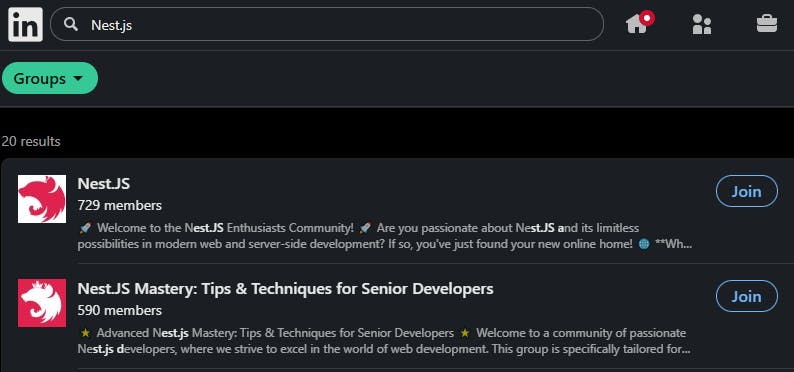
Why is the concentric circles approach good? It prevents strong candidates from getting buried in massive lists you never reach due to time constraints (since LinkedIn and email sending limits apply daily).
Another great technique to find top Node.js developers is to target developers working at companies known for Node.js: Netflix, LinkedIn, PayPal, Uber, Microsoft, and Walmart - organizations that use Node.js for backend services at scale. Check GitHub repositories for Node.js contributions and npm package authorship.
Once you have a list of potential candidates, it's time to write an outreach email/message. The effective outreach message must be short (ideally under 300 characters for LinkedIn, and slightly longer for email). Include the exact Node.js version and framework you're using, the technical challenge candidate will own, and the salary range.
Here's the example of a good outreach message:
"Hi Carlos - saw your microservices work with Node.js 18 and Kafka at Stripe. We're rebuilding payment processing with similar event-driven architecture (Node.js 20, Nest.js, 50K transactions/hour) and need someone who understands async patterns at scale. $130-160K, fully remote. Worth a quick chat? [calendar link]"
What Questions to Ask During the Interview for a Node.js Developer Role
Ask questions that generate technical discussion rather than right/wrong answers. You're assessing depth of understanding and problem-solving approach.
- Event loop and non-blocking I/O: "Explain how Node.js handles concurrent requests with a single thread." This tests fundamental understanding of what makes Node.js different from threaded languages.
- Async pattern evolution: "Walk through the differences between callbacks, promises, and async/await for error handling." Strong candidates discuss callback hell problems and explain when each approach fits. This tests async mastery, not just syntax familiarity.
- Concurrency and scalability: "How would you scale a Node.js application handling 100K concurrent WebSocket connections?" Listen for clustering strategies, worker threads for CPU-intensive tasks, and Redis pub/sub patterns.
- API architecture decisions: "Compare RESTful vs GraphQL API design for a Node.js backend serving mobile and web clients." This tests architectural thinking beyond implementation mechanics.
- Authentication and security: "Describe how you'd implement JWT authentication with refresh tokens in Express." Strong answers include token storage strategies, refresh token rotation, and security considerations.
- Error handling in production: "Walk me through debugging a memory leak in a Node.js Express application." This tests production experience with heap snapshots, profiling, and systematic debugging approaches.
- Real-time features: "How would you architect a real-time chat application with Node.js and WebSockets for 10K concurrent users?" Look for Socket.io vs native WebSockets trade-offs, scaling with Redis adapter, and connection state management.
- Performance optimization: "Our Node.js API response time degrades under load - walk through your systematic debugging approach." Strong candidates discuss APM tools, query optimization, connection pooling, and caching layers.
Green Flags vs Red Flags for Node.js Developers
Category | Green Flags | Red Flags |
Node.js Fundamentals | Explains event loop phases clearly, discusses non-blocking I/O benefits with trade-offs | Vague "Node.js is fast" claims without understanding why, confuses async with multi-threading |
Async Pattern Mastery | Discusses callback hell problems, explains when promises vs async/await fit with error handling strategies | Nested callbacks without understanding issues, can't explain try/catch placement in async/await |
Framework Proficiency | Explains Express middleware chain, discusses when Nest.js structure helps enterprise codebases | Only knows one framework without understanding architectural trade-offs, claims equal expertise in 5+ frameworks |
TypeScript Usage | Proper typing with interfaces and generics avoids any type overuse | Heavy any type usage, claims TypeScript doesn't add value for Node.js |
Database Skills | Discusses connection pooling, query optimization, ORM vs raw SQL trade-offs | No understanding of N+1 problems, can't explain indexing strategies |
Candidates showing 7+ green flags typically pass probation with a 95%+ success rate based on our 150+ Node.js placement data.
How to Do Technical Testing for Node.js Developers
Provide a starter template with a basic Express or Nest.js setup so candidates can focus on implementing features rather than spending time on boilerplate configuration.
- Sample project ideas under 2 hours:
- Build a REST API with Express/Nest.js for user management with JWT authentication
- Create a real-time chat with WebSockets and message persistence
- Implement a data processing pipeline using Node.js streams
- What to evaluate: code organization, async pattern quality with proper error handling and no callback hell, error handling middleware, database integration with connection pooling, testing coverage, and TypeScript discipline if required.
- If you're concerned about AI assistance on take-home tests, conduct a 45-minute live coding session instead. Watch them implement a smaller feature in real time and ask them to explain their architectural choices as they code.
Node.js Developer Skills: Complete Checklist
Use this checklist during candidate evaluation to separate true Node.js backend engineers from full-stack JavaScript developers who just list the framework on their resume.
Must-have technical skills:
- Node.js fundamentals (event loop, non-blocking I/O)
- Async patterns mastery (callbacks, promises, async/await)
- Express or Nest.js proficiency
- RESTful API design and implementation
- Database integration (MongoDB, PostgreSQL)
- Authentication/authorization (JWT, OAuth)
- Error handling and logging patterns
- npm package management
- Testing with Jest or Mocha
- Git version control
Nice-to-have skills:
- TypeScript with advanced typing
- GraphQL with custom resolvers
- WebSocket/Socket.io real-time features
- Microservices architecture experience
- Message queues (Kafka, RabbitMQ, Redis)
- Clustering and worker threads
- Docker containerization
- CI/CD pipeline setup
- Performance profiling and optimization
- Cloud platforms (AWS Lambda, Azure Functions)
Critical remote work skills:
- Async communication clarity
- Self-direction on architecture decisions
- Strong API documentation habits
- Clear written technical communication
Common Mistakes When Hiring Node.js Developers
- Confusing full-stack JavaScript developers with backend Node.js engineers. Developers who know React and basic Express APIs don't necessarily understand event loops, clustering, or scalability architecture. A full-stack generalist using Node.js for simple servers isn't a backend engineer who can architect microservices handling 50K concurrent connections.
- Not specifying framework requirements. Express, Nest.js, and Fastify serve different architectural needs. Vague "Node.js experience" attracts mismatched candidates who've used one framework but not the one you need.
- Ignoring async pattern expertise. Candidates who build simple CRUD APIs may not understand complex async flows, error handling in promise chains, or production debugging of event loop blocking.
- Testing with generic backend questions. Asking about general REST principles instead of Node.js-specific scenarios like event loop mechanics, stream processing, or WebSocket scaling fails to assess true expertise.
- Waiting for applications rather than doing targeted outreach. Best Node.js engineers with scalability experience respond to recruiter messages, not job board posts.
Node.js Developer Hiring Checklist
After analyzing 1,500+ interviews, here's what works when hiring Node.js developers.
Before Hiring
- Create a 1-page recruitment plan with specific Node.js version, framework choice, and backend challenges
- Define a realistic budget using regional salary data
- Write a candidate-focused job description with a salary range
- Set a 48-hour response time target for team feedback
Sourcing
- Search LinkedIn with "Node.js" plus framework filters - not generic JavaScript
- Target companies known for Node.js backend systems
- Send personalized outreach under 300 characters explaining a specific technical challenge
- Use concentric circles approach: start exact, then expand
Assessment
- Conduct structured interviews with the same core questions for all candidates
- Test async pattern mastery and event loop understanding specifically
- Administer practical tests under 2 hours with starter templates
- Evaluate both technical capability and backend architecture thinking
Evaluation
- Look for 7+ green flags from the comparison table
- Assess motivation alongside technical skills
- Verify they can explain trade-offs, not just implement features
Decision
- Meet 4-5 qualified candidates before deciding
- Move quickly with clear compensation and a growth path
Should You Hire Node.js Developers On-Site or Remote?
After placing 150+ Node.js developers, remote hiring consistently outperforms on-site across cost, speed, and access to backend specialists who understand microservices architecture and scalability patterns.
Criteria | Remote Hiring | On-Site Hiring | Why It Matters |
Talent Pool Size | Global - millions of Node.js developers | Local - thousands in any given city | 100x more backend specialists to choose from |
Time to Hire | 48 hours to first candidates with outreach | 2-4 weeks minimum for local sourcing | Faster backend team scaling means faster product shipping |
Cost Range (Senior) | Eastern Europe $48-80K, LatAm $40-70K | US $100-150K | 2x the backend team size at same budget |
Backend Specialists | High availability of microservices and scalability experts globally | Limited by local Node.js talent concentration | Access niche backend expertise easily |
Infrastructure Costs | Minimal - remote setup | $3-7K per seat annually | Significant overhead savings on backend team |
The math is straightforward: hire two experienced Node.js developers remotely for the cost of one US-based hire, without sacrificing quality or communication.
Remote hiring wins for 80% of Node.js projects. Choose on-site only for highly regulated industries requiring physical presence or classified work where remote access is prohibited.
Let Remote Crew Find the Best Node.js Developers for You
Remote Crew specializes in finding, vetting, and placing Node.js developers using a methodology refined across 150+ successful placements. We run Node.js-specific technical interviews that assess async pattern mastery, event loop understanding, and scalability architecture - the expertise gaps that internal HR teams typically can't evaluate.
You'll see your first qualified candidate within 48 hours through our pre-vetted networks in Portugal, Brazil, and across EU and Latin America. Our risk-free model means you don't pay anything until you hire. No upfront fees, no commitments.
The results speak for themselves: 99% of our developers pass probation, 90%+ of candidates pass the first screening, and we see offer acceptance rates 50%+ higher than traditional hiring.
Book a free consultation to discuss your Node.js hiring needs. Remote Crew handles sourcing, screening, and placement so you can focus on building your product instead of sorting through candidates who can't explain the event loop.
FAQ
What's the difference between a full-stack JavaScript developer and a Node.js backend developer?
Full-stack developers use Node.js for simple REST APIs but typically lack depth in event loop mechanics, clustering, microservices architecture, and production scalability patterns. Backend Node.js engineers specialize in async patterns, real-time features with WebSockets, message queues like Kafka or RabbitMQ, and architecting systems that handle 10K+ concurrent users. Test specifically for these deeper competencies - ask candidates to explain worker threads, event-driven architecture, and how they'd scale a service under load.
How much should I pay a Node.js developer in 2026?
US senior Node.js developers earn $130K-$180K annually, while Eastern European equivalent talent costs $70K-$100K and Latin American developers range $60K-$90K. Node.js developers with microservices and real-time experience command 10-15% premiums over basic API developers. Contract and specialized hourly rates vary from $35-$65/hour in Asia to $100-$150/hour in North America. Remote hiring from Poland, Portugal, Brazil, or Argentina delivers 40-60% cost savings without sacrificing backend expertise.
Should I hire Express or Nest.js developers?
Express offers flexibility and simplicity for startups and smaller APIs where rapid iteration matters and your team has strong architectural discipline. Nest.js provides an enterprise structure with a TypeScript-first design, dependency injection, and opinionated architecture - ideal for larger teams or developers coming from Angular backgrounds. Match framework choice to your team size, architectural needs, and whether you value flexibility over structure. Nest.js reduces architectural debates on bigger teams, while Express lets experienced developers move faster.
What's the best country to hire Node.js developers from?
Three tiers work best: Eastern Europe, particularly Poland and Portugal, offers strong computer science education and below-average European salaries with excellent timezone overlap. Latin America, especially Brazil, Argentina, and Mexico, provides top talent at 40-60% of US costs with compatible business hours for real-time collaboration. Southeast Asia offers maximum cost savings, but timezone differences require async workflows. Choose based on your need for synchronous collaboration versus budget optimization - timezone overlap matters more for backend architecture decisions.
How long does it take to hire a qualified Node.js developer?
A structured approach delivers first candidates in 48 hours through targeted outreach. Meeting 4-5 qualified candidates leads to your hiring decision. The total timeline is 4-6 weeks from requirements definition to a signed offer. Contrast this with unstructured approaches taking 12-16 weeks through job board posting, vague requirements, and wasted interviews. The difference comes from investing in the preparation phase and active sourcing versus passive waiting for applications that never arrive from top candidates.
Tech hiring insights in your inbox
From engineers to engineers: helping founders and engineering leaders hire technical talent.
We will only ever send you relevant content. Unsubscribe anytime.