

Most companies when hiring remote developers search for PHP developers and attract candidates who write legacy procedural code incompatible with modern application architecture. They waste weeks interviewing candidates who look qualified on paper but are stuck in PHP 5.x patterns from a decade ago.
The problem runs deeper than outdated syntax. Candidates can't explain dependency injection, have never used Composer for package management, or struggle with basic OOP design patterns. The gulf between listing PHP on a resume and architecting scalable applications with Laravel or Symfony is massive.
At Remote Crew, we've hired 150+ remote developers and interviewed 1,500+ candidates across every role. The insights you're about to see on how to hire the best PHP developers come from real experience.
This guide covers everything you need to hire the best PHP developers: before-hiring preparation, during-hiring assessment, and practical checklists for PHP-specific candidate evaluation.
You'll learn how to identify true Laravel/Symfony expertise, avoid the experience trap, and access global PHP talent at 40-60% cost savings without quality compromise.
Key Takeaways
- Modern PHP (8.x) with Laravel or Symfony is fundamentally different from legacy PHP (5.x/7.x) or basic WordPress development.
- Laravel remains the default choice for 80% of new PHP projects in 2026, commanding higher adoption rates than Symfony
- PHP developers earn an average of $108,140 annually in the United States, while remote PHP developers earn $65,613 globally. Eastern Europe and Latin America offer senior talent at $40-68K versus $90-130K domestically - a 40-60% cost reduction without sacrificing quality.
- Outreach delivers first candidates in 48 hours, while job boards take weeks and attract only candidates with limited options.
- Testing for modern PHP features separates qualified candidates from pretenders.
- Remote hiring wins for 80%+ of PHP projects.
When Do You Need PHP Developers?
PHP developers become essential when you're building systems that demand robust database integration, proven frameworks, and enterprise-grade reliability. You need them for:
- e-commerce platforms and custom shopping experiences - WooCommerce customization for content-heavy stores, Magento development for complex product catalogs, and Shopify backend integrations when you need functionality beyond the standard API.
- SaaS web applications with complex business logic and database integration benefit from PHP's mature ecosystem.
- Content management systems beyond basic WordPress require PHP expertise - custom CMS development, Drupal 9/10 projects, and headless CMS backends that need flexible content modeling and multi-channel publishing.
- Legacy PHP codebase modernization projects represent a massive opportunity. Migrating from PHP 5.6/7.4 to PHP 8.2+ or upgrading procedural code to framework-based architecture is common in long-lived enterprise applications carrying technical debt.
- Database-driven web applications requiring complex queries, caching strategies (Redis, Memcached), and performance optimization at scale benefit from PHP's decades of database tooling maturity.
Use Case | PHP Fits When | Consider Alternatives When |
E-commerce | Existing WooCommerce/Magento stack, large product catalogs | Greenfield projects prioritizing the JavaScript ecosystem |
API Development | Mixed tech stack, rapid prototyping needs | Microservices requiring extreme concurrency |
CMS Projects | WordPress/Drupal ecosystem, content-heavy sites | Headless-first architecture |
Legacy Modernization | Existing PHP codebase, gradual migration strategy | Complete rewrite justified |
Web Applications | Database-centric CRUD operations, server-side rendering | Real-time features dominating requirements |
Three Stages of Hiring PHP Developers
Successful PHP hiring requires three structured phases:
- Phase 1 (Before Hiring) - Define your 1-page recruitment plan: Laravel vs Symfony vs WordPress needs, PHP version requirements (7.4+ vs 8.x), salary expectations, and job descriptions that attract modern framework developers.
- Phase 2 (During Hiring) - Source through targeted outreach, conduct structured technical interviews, administer 2-hour practical tests, and evaluate both technical skills and motivation.
- Phase 3 (After Hiring) - Onboard with documentation, set 60-day milestones, and create feedback loops to catch issues early.
This guide focuses on Phases 1 and 2, as these determine hiring success before you extend an offer.
Part 1 - Setting Up the Foundations for Hiring PHP Developers
Most hiring managers jump straight to posting jobs and wonder why they waste weeks interviewing candidates who can build WordPress themes but can't explain dependency injection in Laravel.
Understanding your needs and aligning them with the right seniority level prevents hiring the wrong PHP developers from the start.
Create Your 1-Page Recruitment Plan for PHP Developers
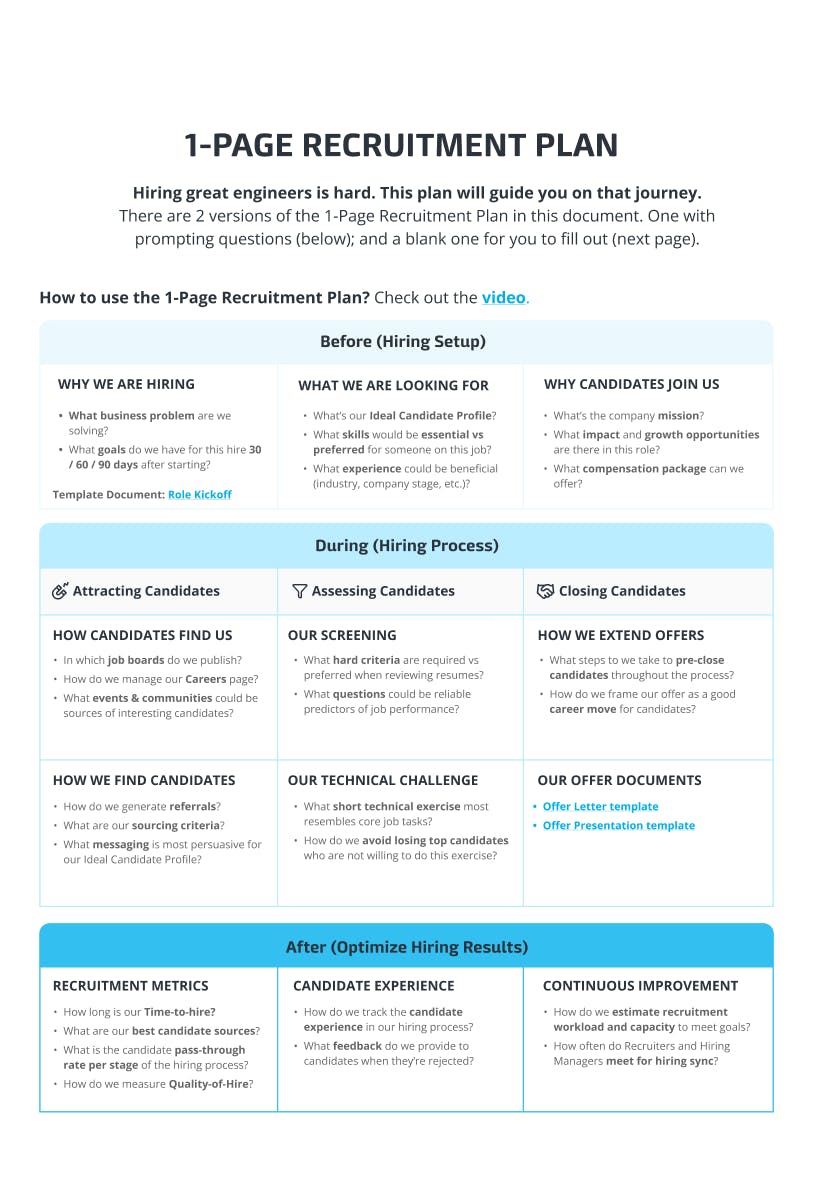
A 1-page recruitment plan aligns stakeholders before you waste time on misaligned candidates. After analyzing 1,500+ interviews, we've found three sections that work.
- Business Problem: Be specific. Not "backend development" - that means nothing. Instead: "Migrate booking system from legacy PHP 7.4 to Laravel 10 with queue-based email processing, serving 50K daily reservations" or "Rebuild property management platform with Laravel 10 and Vue.js, affecting 20K landlords processing $10M monthly rent." Specify PHP version requirements (7.4+ vs 8.x), framework needs (Laravel vs Symfony), migration requirements from legacy PHP, and specific features needed.
- Technical Requirements: Differentiate must-haves from nice-to-haves explicitly. Must-haves: PHP 8.x, Laravel/Symfony experience, Composer proficiency, MySQL knowledge. Nice-to-haves: WordPress experience, Redis caching, Docker containerization, microservices architecture exposure. This prevents filtering out strong Laravel developers who lack secondary WordPress skills.
- Why They'd Join: Highlight technical challenges they'll own, the framework they'll work with, and learning opportunities from your team. Include compensation structure and growth path.
Download our free 1-page recruitment plan template to get started faster.
Understanding PHP Seniority Levels
Define what "junior," "mid-level," and "senior" actually mean for your specific needs.
- Junior (1-3 years): Basic PHP syntax and OOP principles, Laravel/Symfony following existing patterns, CRUD operations, MySQL queries, form validation, PSR standards with guidance. They need architectural direction but can implement features independently.
- Mid-level (3-5 years): Deep framework proficiency with Laravel or Symfony, dependency injection understanding, complex database relationships, RESTful API development, PHPUnit testing experience, security best practices (OWASP), and design patterns application.
- Senior (5+ years): Framework architecture decisions, module design strategy, event-driven architecture implementation, PHP version migrations (7.4 to 8.x), mentoring capabilities, performance optimization at scale. They make confident calls on system-wide architectural trade-offs.
Warning: A motivated 4-year PHP developer excited about modern Laravel features will outperform a burned-out 8-year developer stuck in legacy patterns. Motivation and PHP-specific expertise predict success more reliably than raw years of experience.
Salary Expectations for PHP Developers
Modern frameworks like Laravel and Symfony command higher rates because expertise in these frameworks for enterprise applications requires greater skill than basic PHP, but the broader talent pool of Angular keeps rates 5-10% lower.
Region | Junior (Annual) | Mid-Level (Annual) | Senior (Annual) | Hourly Rate (Specialized/Contract) |
North America | $60K-$80K | $80K-$110K | $90K-$130K | $90-$135 |
Western Europe | $45K-$62K | $60K-$88K | $68K-$112K | $70-$105 |
Eastern Europe | $30K-$45K | $42K-$62K | $48K-$75K | $45-$70 |
Portugal | $28K-$42K | $38K-$58K | $45K-$72K | $40-$65 |
Latin America | $26K-$38K | $35K-$52K | $40K-$68K | $36-$60 |
How to Write a Compelling Job Description for PHP Developers?
Be clear and specific from the start. For example, "Rebuild property management platform with Laravel 10 and Vue.js, affecting 20K landlords processing $10M monthly rent." Specify PHP version and framework requirements (PHP 8.2+, Laravel 10+, Symfony 6+) to filter appropriately.
Avoid the common mistake of requiring "PHP/Python/Node.js experience" - this signals you don't understand what you need.
Include a salary range, as candidates often skip postings without compensation transparency. Frame as a career opportunity with a learning path, team details, and technical ownership.
PHP Job Description Must-Haves:
- Specific PHP version you're using (e.g., "PHP 8.2+", not just "PHP")
- Required framework (Laravel, Symfony, or "vanilla PHP with specific libraries")
- CMS experience if relevant (WordPress, Drupal, Magento with version)
- Database proficiency level expected (MySQL, PostgreSQL, Redis)
- Salary range or "Competitive salary" with specific equity details
- Testing expectations (PHPUnit, integration testing, coverage requirements)
- Team structure: who they'll work with and learn from
- Red flag to avoid: Never list "PHP/Python/Node" together - shows a lack of clarity on what you need
Part 2 - During Hiring: How to Identify the Best PHP Developers
Most companies post jobs and wait for applications. That's the wrong approach. The best PHP developers don't browse job boards - they respond to targeted outreach when you demonstrate you understand modern PHP and offer something compelling.
How to Source PHP Developers on LinkedIn
We've tried many different ways to find and reach ideal candidates on LinkedIn, and we've found that the best approach is the concentric circles method.
In a nutshell, to build a great list of candidates, start your LinkedIn search narrowly by including the exact (and most important) requirements - i.e., Laravel 10+ OR Symfony 6+, PHP 8.2+, seniority level, location, etc.
Reach out to this tier first. Then, progressively relax the criteria to expand your potential candidate pool.
Why is the concentric circles approach good? It prevents strong candidates from getting buried in massive lists you never reach due to time constraints (since LinkedIn and email sending limits apply daily).
Another great technique to find top PHP developers is to target developers working at SaaS platforms, e-commerce companies, digital agencies, and Laravel/Symfony shops, since these organizations typically use modern PHP frameworks for maintainability and scalability. Check GitHub repositories for PHP contributions and Packagist profiles for package authorship.
Once you have a list of potential candidates, it's time to write an outreach email/message.
The effective outreach message must be short (ideally under 300 characters for LinkedIn, and slightly longer for email). Include the exact PHP version and framework you're using, the technical challenge candidate will own, and the salary range.
Here's the example of an effective outreach message:
"Hi Sarah - saw your work on the payment processing refactor to Laravel 10 at Shopify. We're rebuilding our inventory system with similar architecture (Laravel 11, PHP 8.3, 200K SKUs) and need someone who understands service providers and complex Eloquent relationships at scale. $95-120K, fully remote. Worth a quick chat? [calendar link]"
Interview Questions for PHP Developer Roles
Ask questions that generate technical discussion rather than right/wrong answers. You're assessing depth of knowledge and systematic thinking.
- "Explain PHP 8.x features you use regularly and why?" - Tests modern PHP knowledge. Strong candidates discuss attributes for metadata, named arguments for readability, union types for type safety, and enums for type-safe constants.
- "How does dependency injection work in Laravel/Symfony, and when would you use constructor vs method injection?" - Tests fundamental framework understanding. Look for explanations of service containers, constructor injection for required dependencies, and method injection for optional or context-specific dependencies.
- "What's the difference between abstract classes and interfaces, and when would you choose one over the other?" - Tests object-oriented principles. Great answers explain that abstract classes share implementation while interfaces define contracts, with examples of when each makes sense.
- "Which PSR standards do you follow and why?" - Tests coding standards knowledge. Candidates should mention PSR-4 for autoloading and PSR-12 for code style as minimums.
- "How would you optimize a slow Eloquent query causing N+1 problems?" - Tests practical ORM proficiency. Strong candidates immediately mention eager loading with with(), explain query reduction, and can articulate when to use lazy loading vs eager loading.
- "How do you prevent SQL injection and XSS attacks in Laravel/Symfony?" - Tests security best practices. Look for discussions of parameterized queries, Eloquent's built-in protections, output escaping, and CSRF token validation.
- "Our Laravel app times out during CSV imports with 50K rows - walk me through your debugging approach" - Tests systematic problem-solving across layers: chunk processing, queue jobs, memory limits, database indexing, and progress tracking.
- "How would you migrate a legacy PHP 5.6 codebase to Laravel with PHP 8.2?" - Tests architectural thinking and migration experience. Strong candidates discuss gradual strangler pattern migration, breaking change identification, and testing strategies.
Green Flags vs Red Flags for PHP Developers
Category | Green Flags | Red Flags |
Modern PHP Knowledge | Uses PHP 8.x features naturally (attributes, enums, and readonly properties) | Still writing PHP 5.x style code, unaware of modern features |
Framework Proficiency | Deep Laravel/Symfony knowledge with middleware, service providers, and Eloquent relationships | Only knows basic routing and controllers, struggles with advanced concepts |
OOP & Design Patterns | Discusses SOLID principles, dependency injection, and the repository pattern with examples | Writes procedural code in OOP frameworks, no pattern knowledge |
Database Skills | Optimizes queries, understands indexes, uses migrations and seeders | Writes raw queries without parameterization, no migration experience |
Testing Approach | Writes PHPUnit tests, knows feature vs unit testing, uses mocking | Has never written tests or only basic assertions |
Candidates who show 7+ green flags typically pass probation with a success rate of 95%+ based on our placement data.
Technical Testing for PHP Developers
Here are the best practices for running technical tests when hiring PHP developers:
- Keep tests under 2 hours. Longer tests filter out candidates with options. Provide starter templates, so candidates implement features rather than spending time on boilerplate setup.
- Sample project ideas that mirror real work: Build a REST API with Laravel for blog CRUD operations with authentication, refactor legacy procedural PHP to modern OOP Laravel, or create a database-heavy feature with complex relationships and eager loading.
- Evaluate code organization, OOP principles application, framework conventions adherence, database query efficiency, security implementation, and PSR standards compliance.
- If concerned about AI assistance on take-home tests, conduct a 45-minute live coding session instead. Modern developers use AI tools in daily work - focus on whether they can explain their choices, understand trade-offs, and articulate reasoning.
PHP Developer Skills - Complete Checklist
Use this checklist during candidate evaluation to separate strong PHP developers from those who just list the framework on their resume.
Must-Have Technical Skills:
- Modern PHP 8.x proficiency with new features (attributes, enums, readonly properties)
- Laravel or Symfony framework expertise with deep architectural understanding
- OOP principles and design patterns (SOLID, dependency injection, repository pattern)
- MySQL/PostgreSQL database management with query optimization
- RESTful API development with proper authentication
- Composer dependency management and package versioning
- Git version control with branching strategies
- PHPUnit testing including feature and unit tests
- Security best practices following OWASP guidelines
- PSR standards compliance (PSR-4, PSR-12)
Nice-to-Have Skills:
- WordPress/Drupal CMS expertise
- Redis/Memcached caching implementation
- Docker containerization experience
- CI/CD pipeline setup
- Frontend basics (JavaScript, Vue/React)
- GraphQL API development
- Microservices architecture exposure
- Static analysis tools (PHPStan, Psalm)
Critical Remote Work Skills:
- Async communication clarity
- Self-direction without constant oversight
- Strong documentation habits
- Clear written technical communication
Common Mistakes When Hiring PHP Developers
After 1,500+ interviews, these mistakes consistently derail PHP hiring:
- Confusing legacy with modern PHP. Generic "PHP experience" requirements attract outdated skillsets. Specify the version - PHP 5.6 and PHP 8.2 are drastically different technologies.
- Treating WordPress and custom application developers as interchangeable. They require different expertise. A WordPress theme builder won't necessarily architect a Laravel microservice.
- Testing with outdated knowledge. Questions about deprecated features signal you're stuck in 2005. Ask about attributes, enums, and readonly properties instead - inability to discuss these reveals outdated knowledge.
- Ignoring framework-specific expertise. Laravel developers and Symfony developers have different skill profiles. Don't assume they're interchangeable.
- Overlooking security knowledge. Probe for OWASP Top 10 understanding and framework-specific security features like CSRF protection and input validation.
- Waiting for inbound applications. Best developers respond to targeted outreach, not job boards. Direct messages get first responses.
- Skipping role definition. Jumping to interviews without stakeholder alignment wastes weeks on misaligned candidates.
PHP Developer Hiring Checklist
After 1,500+ interviews, here's what works when hiring PHP developers.
- Before Hiring
- Create a 1-page role kickoff document defining PHP version (8.x specifically), framework (Laravel/Symfony), CMS needs (WordPress vs custom), and business impact.
- Set a realistic budget using regional salary data from the tables above.
- Write a candidate-focused job description that includes the salary range and specific PHP/framework versions.
- Sourcing
- Search LinkedIn with "Laravel" OR "Symfony" plus PHP 8.x version numbers.
- Target SaaS companies, e-commerce platforms, and digital agencies known for modern PHP.
- Check GitHub and Packagist for open-source contributions.
- Send personalized outreach under 300 characters explaining the framework and the PHP version needed.
- Assessment
- Use structured interview questions consistently across all candidates.
- Test modern PHP knowledge (8.x features specifically).
- Evaluate framework proficiency with real-world scenarios.
- Assess security awareness (OWASP, input validation).
- Administer practical tests under 2 hours with starter templates provided.
- Evaluation
- Assess motivation alongside technical capability.
- Green flags: uses modern PHP features, follows PSR standards, writes tests.
- Red flags: legacy PHP mindset, no framework depth, security ignorance.
- Decision
- Move quickly - meet 4-5 qualified candidates before deciding.
- Extend offers with a clear compensation structure and growth path.
Should You Hire PHP Developers On-Site or Remote?
Remote PHP developers deliver better results than on-site hires across cost, speed, and access to specialists.
Criteria | Remote Hiring | On-Site Hiring | Why It Matters |
Talent Pool Size | Global (millions) | Local (thousands) | 100x more candidates to choose from |
Time to Hire | 48 hours to the first candidates | 2-4 weeks minimum | Faster hiring means faster shipping |
Cost Range (Senior) | Eastern Europe $48-75K, LatAm $40-68K | US $90-130K | 2x the team at same budget |
PHP Framework Specialists | High availability globally | Limited by local market | Access niche expertise easily |
Infrastructure Costs | $0-minimal remote setup | $3-7K per seat annually | Significant overhead savings |
Let Remote Crew Find Your PHP Developers
Remote Crew specializes in finding, vetting, and placing remote PHP developers using a methodology refined across 150+ successful placements.
We conduct PHP-specific technical interviews that internal HR teams can't handle: framework assessments for Laravel and Symfony, modern PHP knowledge evaluations covering 8.x features like attributes and enums, and security awareness testing for OWASP vulnerabilities. This fills the expertise gap most hiring managers face.
You'll see your first qualified PHP candidate within 48 hours through our pre-vetted networks in Portugal, Brazil, and across the EU and Latin America.
Our risk-free model means you pay nothing until you hire. We work on a role-by-role basis without upfront fees.
The results: 99% of developers pass probation, 90%+ of candidates pass the first screening, and the offer acceptance rate is 50%+ higher than in traditional hiring.
Book a free consultation to discuss your PHP hiring needs. Remote Crew handles sourcing, screening, and placement so you can focus on building your product instead of speaking with unqualified candidates.
FAQ
What is the difference between hiring a WordPress developer and a PHP developer?
WordPress developers specialize in the CMS ecosystem, building themes, extending plugins, creating Gutenberg blocks, and working with WordPress-specific APIs such as hooks and filters. They know WordPress conventions well but typically work within the platform's constraints.
Custom PHP application developers architect scalable applications from scratch using modern frameworks like Laravel or Symfony. They understand dependency injection, service containers, OOP design patterns, PSR standards, and how to structure applications for long-term maintainability. They build RESTful APIs, design database schemas, implement caching strategies, and handle complex business logic outside the WordPress ecosystem.
How much should I pay a PHP developer in 2026?
Senior PHP developers in the US markets earn $90-130K annually. Remote developers offer significant savings: Eastern Europe $48-75K, Latin America $40-68K. Modern framework expertise (Laravel 10+, Symfony 6+) commands premiums over basic PHP. Salaries vary by seniority level, framework specialization, and whether work involves legacy maintenance versus new development.
Should I hire a Laravel developer or a Symfony developer?
Laravel suits 80% of projects: SaaS products, startups prioritizing speed to market, teams valuing convention over configuration. Symfony fits enterprise applications requiring long-term stability, complex projects needing reusable components, and teams wanting architectural control. Both are production-ready; choose based on project complexity, development speed needs, and team preferences.
What's the best country to hire remote PHP developers from?
Eastern Europe (Poland, Romania) offers strong technical talent at $48-75K with 5-7 hour US overlap. Latin America (Brazil, Argentina) provides top talent at $40-68K with complete US time zone alignment. Portugal delivers Laravel/Symfony expertise at $45-72K with GMT positioning ideal for East Coast companies. Choose based on time zone needs and budget.
How long does it take to hire a qualified PHP developer?
With structured preparation and targeted outreach, expect the first qualified candidates within 48 hours. After meeting 4-5 candidates, decisions happen within 2-3 weeks. Total timeline: 4-6 weeks from role definition to signed offer. Without structure - vague job posts, no alignment - expect 12-16 weeks and mediocre outcomes. Preparation determines speed and quality.
Tech hiring insights in your inbox
From engineers to engineers: helping founders and engineering leaders hire technical talent.
We will only ever send you relevant content. Unsubscribe anytime.