

What if every day without that senior backend engineer is costing you three feature releases, two frustrated customers, and one burned-out engineering manager who's threatening to quit?
At Remote Crew, we've watched scenarios like this play out at 70+ tech companies. The pattern is always the same: fast-growing startups underestimate how long it takes to hire a remote developer, launch a hiring sprint with unrealistic timelines, and then watch their roadmap collapse as weeks turn into months.
The average company takes 38 to 50 days to fill a software engineering role, but we've seen hiring drag on for 90+ days when teams don't have a structured process.
We must protect your company from:
- Lost revenue
- Technical debt accumulation
- Team morale erosion
How? My team has a framework to reduce the hiring process duration for software engineers.
This is a framework we’ve developed and refined over the years as we’ve assembled technical teams.
In this article, I've used our experience partnering with dozens of tech companies and 2024-2025 benchmark data from thousands of engineering hires to define the remote developer hiring timeline.
You'll see where most companies waste time, which stages you can compress, and how geography affects your hiring speed.
I’ll show you the difference between a 35-day hire and an 82-day disaster.
If you feel a spark of relief once you've scrolled through this article, knowing you could finally start hiring remote technical talent faster, I want you to take this as a sign to move forward with us.
We'll find your first candidate for a remote developer position at your company within 48 hours. Deal?
How Long Does It Take To Hire A Remote Developer In 2026?
The hiring process duration for software engineers varies more than most founders expect.
According to SmartRecruiters' 2025 Recruitment Benchmarks Report, the global median time to hire sits at 38 days across all industries.
But software engineering roles consistently skew longer.
Paraform's recent analysis of engineering hires found that the median time-to-hire stretches to 41 days, with the slowest 10% of companies taking up to 82 days to close a single role.
From what we’ve seen over the years, the difference between a 40 and an 80-day hiring timeline is immense.
Why the wide range?
Gem's 2024 Recruiting Benchmarks tell us something critically important…
Hiring teams now conduct 42% more interviews per hire compared to 2021.
This interview inflation pushed average hiring timelines from approximately 33 days to 41 days in just three years.
We don’t like this approach because it creates three problems:
- Added scheduling friction as things drag on.
- Greater risk of candidates dropping out.
- Candidates may accept competing offers.
HireHive's 2024 study found that 64% of companies take 4 to 8 weeks to hire, while 27% take more than 8 weeks.
We think that’s far too long.
For remote tech roles specifically, Recruiterflow data shows software positions typically require 40 to 50 days.
Some efficient teams at companies like those documented by Binarcode achieve closer to 35 days.
These benchmarks for hiring remote developers tell us something important…
If you're taking longer than 50 days, you're in the slowest quartile.
But if you're consistently hitting 35-42 days, that’s competitive.
Anything faster requires either an exceptional process or compromises on candidate quality.
Fortunately, at Remote Crew, we’ve worked hard over the years to develop an ambitious hiring process that wastes no time in finding excellent technical talent.
Our goal is to present qualified candidates to you within the first 48 hours.
The Real Remote Developer Hiring Timeline
We’re focused on moving fast and sourcing candidates quickly.
As you can see in the example hiring timeline below, there is no time to waste:
Hiring Stage | Duration | Activities | Bottlenecks |
Sourcing & Outreach | 1-2 weeks | Job posting, active sourcing, referrals, initial outreach | Poor job descriptions, limited talent pool, slow response to candidates |
Resume Screening | 2-3 days | CV review, initial qualification check | Vague requirements, too many unqualified applicants |
First-Round Interviews | 1-2 weeks | Recruiter screens, hiring manager calls | Calendar coordination, too many interviewers involved |
Technical Assessments | 1 week | Coding challenges, take-home projects, technical screens | Overly complex tests, delayed candidate submission, slow grading |
Final Interviews | 1 week | Team interviews, culture fit, leadership meetings | Too many approval layers, scheduling conflicts |
Offer & Negotiation | 1-2 weeks | Offer preparation, negotiation, reference checks | Slow internal approvals, compensation misalignment |
Notice Period (if applicable) | 2-8 weeks | Candidate serves notice at current employer | EU notice periods average 1-2 months vs. US 2-week standard |
If we don’t act with urgency, candidates may drop out and accept job offers elsewhere.
We don’t leave any room for this to happen.
Here’s how we make every day count…
Sourcing: 1-2 Weeks
Your time to hire remote developers starts the moment you decide to open a role.
Geography dramatically affects sourcing speed.
If you're hiring from major tech hubs with established talent pools like Portugal, Brazil, or Poland, you can surface qualified candidates within days.
Less common locations can push sourcing past the two-week mark.
To achieve the fastest hiring results, teams must proactively combine inbound job postings with active outreach to passive candidates, make use of employee referral networks, and continuously cultivate talent pipelines from past hiring cycles.
Screening & Interviews: 2-3 Weeks
From our experience, this is where factors affecting hiring speed become most visible.
The more people involved in your interview process, the longer this stage takes.
Gem's research showing 42% more interviews per hire directly translates to scheduling complexity.
A lean process might look like this:
- Recruiter screen (30 minutes)
- Hiring manager interview (45 minutes)
- Technical screen (60 minutes)
- Team interview (60 minutes)
That's four touchpoints across two to three weeks if you're efficient.
A bloated process might involve other stages like peer interviews, system design interviews, and executive interviews.
If you add more touchpoints, this process can easily stretch to four weeks when accounting for calendar conflicts and feedback delays.
Technical Assessments: 1 Week
Most remote developer roles include some form of technical evaluation.
This might be a live coding session, a take-home project, or a combination of the two.
The one-week estimate assumes you give candidates three to five days to complete a take-home assignment and two to three days for your team to review submissions.
At Remote Crew, we’ve found that companies can reduce time-to-hire for remote developer roles by using standardized, pre-built assessments rather than custom projects.
The trade-off is less role-specific evaluation, but the time savings are often significant.
We can help you build standardized assessments that can be used when hiring for many different technical roles.
Offer & Negotiation: 1-2 Weeks
Even after you've identified your top candidate, closing the deal takes time.
Internal approvals for compensation, reference checks, background verification, and contract preparation typically require one week at the very minimum.
If negotiation extends beyond initial expectations or you need additional approval layers, this can stretch to two weeks.
Contractual Notice Periods Can Cause Significant Delays
This is where remote hiring gets tricky.
US-based contractors often have minimal or no notice periods and can start within days of signing.
EU-based employees commonly have contractual notice periods of 1-2 months. Brazilian developers might have 30 days. Asian markets vary widely.
If you're hiring a senior developer from Portugal who has a three-month notice period, your actual time-to-start extends far beyond your time-to-hire.
This doesn't appear in most benchmarks but dramatically affects your planning.
So, what can we do to fix this?
Unfortunately, there is nothing we can do on our side.
We are focused on progressing through the other stages of the hiring process as quickly as possible.
The faster we can get an offer on the table for an exceptional candidate, the sooner they can hand in their notice and complete their contractual obligations to their current employer.
Does Speed Always Matter?
Optimizing the time it takes to hire remote developers doesn't always mean hiring faster at all costs.
If you're filling a principal engineer role that will influence your architecture for the next three years, taking 60 days (or even 90) to find exactly the right person beats rushing a 30-day hire who's merely adequate.
We know the financial damage inflicted by a poor senior hire significantly outweighs the cost of extending the search by a few extra weeks.
If you're scaling a team and need to add five mid-level developers in the next quarter, speed matters.
Every week of delay multiplies across five open roles.
This is when process optimization, pipeline development, and specialized recruiting support are mission-critical.
A startup racing toward a funding deadline has different speed requirements than an established company making a strategic hire.
8 Best Practices To Reduce Time To Hire Remote Developers
The companies with 35-day hiring cycles follow distinct patterns that set them apart from the 82-day stragglers.
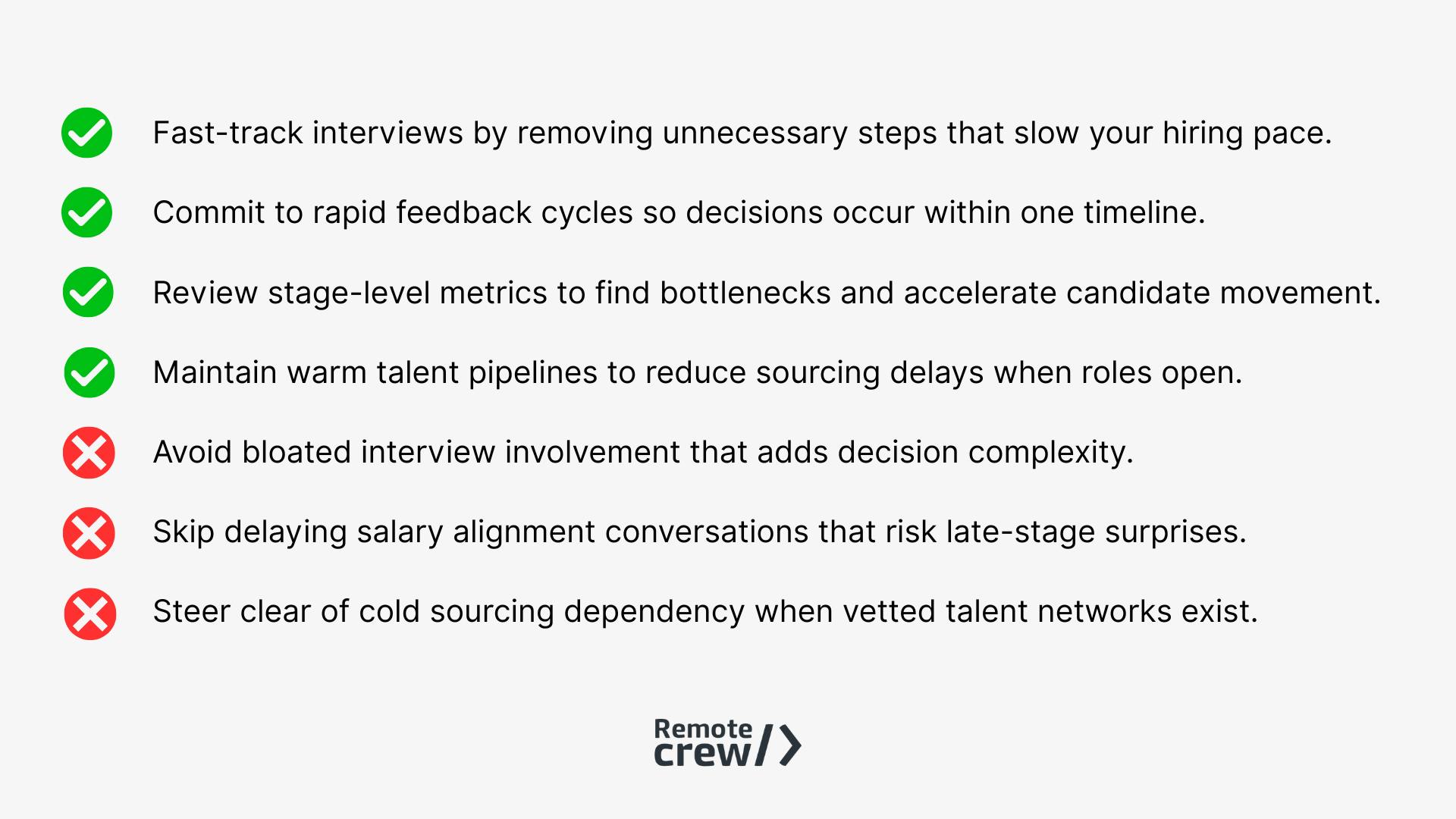
I want you to take some of our best practices into consideration:
1 - Fast-track your interview process ruthlessly
Question every interview round.
Does your VP of Engineering really need to interview every mid-level hire?
Can you combine your technical screen and system design interview into a single session?
Each eliminated touchpoint saves five to seven days.
2 - Make decisions within 24 hours
I like to set a team norm: feedback from every interview must be submitted within 24 hours, and hiring decisions must be made within 24 hours of the final interview.
This alone can compress your timeline by two weeks.
3 - Study the data to find bottlenecks
Track time-to-hire by stage, not just overall.
When candidates consistently drop out after technical assessments, this indicates your tests are either too long or too difficult.
If scheduling first-round interviews takes 10 days, you need better calendar coordination.
A glance at the data will unveil potential flaws in your current processes.
We love using data to find easy wins.
I’m confident we can uncover several quick wins simply by reviewing your hiring process data.
4 - Build talent pipelines before you need them
The fastest hires come from warm pipelines.
These are:
- Candidates you've been talking to for months
- Past applicants who weren't quite right before
- Referrals from your network.
Sourcing time drops from two weeks to two days when you're drawing from an existing pool.
5 - Partner with specialists who know remote markets
This is where our model delivers measurable value that you’ll notice within 48 hours of partnering with us.
We maintain networks of 10,000+ vetted engineers across Europe and South America.
Our clients see qualified candidates within 48 hours rather than waiting weeks for job board applications to trickle in.
6 - Standardize your technical assessments
We recommend creating reusable coding challenges and evaluation rubrics.
When every candidate gets the same assessment, and every evaluator uses the same scoring criteria, you eliminate review delays and reduce the risk of bias.
7 - Front-load compensation discussions
Address salary expectations in the first conversation, not the fifth.
If a candidate's expectations exceed your budget by 40%, you need to know immediately, not after investing three weeks in interviews.
8 - Account for geography in your planning
Those hiring from regions with long notice periods must factor this into their roadmaps.
A developer who can't start for 10 weeks might still be your best option if they're the right fit, but you must know this upfront to plan accordingly.
Tech hiring insights in your inbox
From engineers to engineers: helping founders and engineering leaders hire technical talent.
We will only ever send you relevant content. Unsubscribe anytime.